Guida all'ingrosso per custodie per carte collezionabili: Approvvigionamento per rivenditori di oggetti da collezione
Risposta rapida
Retailers should source a custodia per carte collezionabili by matching the holder format, slab dimensions, capacity, display needs and handling method to their customers’ collections. Compare aluminum, acrylic and cardboard by use rather than assuming one is best for every channel. Confirm usable capacity with actual PSA, BGS or other holders, then check MOQ, packaging, branding and inspection terms on a sample. SUNCASE lists graded-card display and storage cases; verify holder fit and exact capacity for each model before placing a wholesale order.
What Should Retailers Know About Trading Card Case Demand?
Collectibles retailers serve customers who store, transport, display and sell cards in different ways. Some want a trading card storage box for a growing collection; others need a graded card case that keeps slabs organized for shows or resale. These use cases shape case format, capacity, interior protection and price point.
Demand also varies by game, sport, grading service and season. Avoid building an assortment around a broad market-growth claim unless you have current, relevant sales data for your region. Instead, use your own customer questions, sell-through and replenishment history to decide which capacities and finishes are worth stocking.
For procurement, the practical takeaway is to source a small, clearly differentiated range. A compact display case, a portable slab case and a higher-capacity storage case solve different jobs. Keep the product specifications and intended holder types explicit so customers can select the right option and retailers can reduce fit-related returns.
Which Case Types Should a Collectibles Retailer Compare?
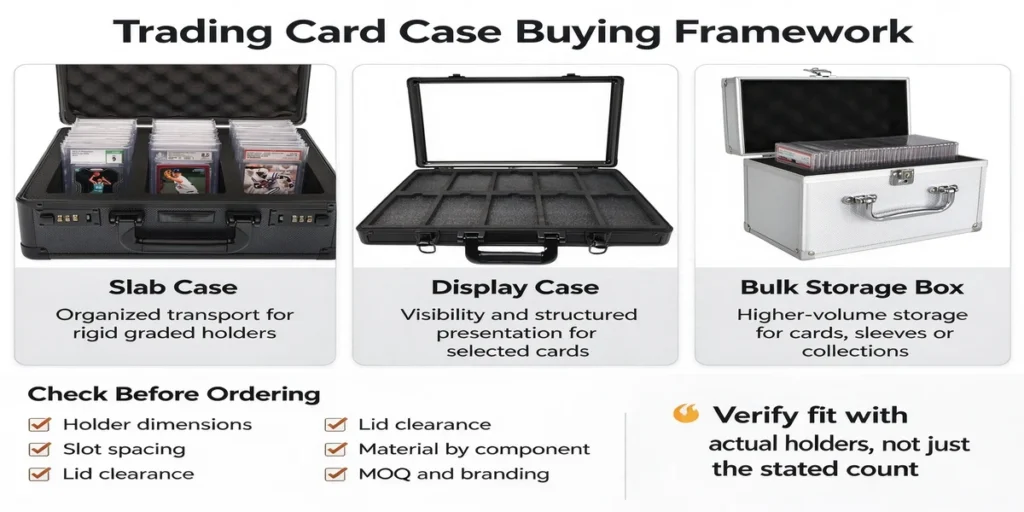
“Trading card case” can refer to a display case, a graded card case, a storage box or a carry case. Confirm whether the buyer needs individual graded slabs, raw cards in sleeves, sealed products or a mixed assortment. These formats need different compartments and may not fit the same case.
What is a slab case?
A slab case stores graded cards sealed in rigid holders, often with slots, dividers or a fitted interior. Confirm the holder dimensions supported, orientation, retention and capacity. Do not assume every grading company’s holder has the same outside dimensions.
When is a display case a better choice?
A display case lets collectors or retailers show selected cards while storing or transporting them. Check visibility, closure, support and whether the display format suits counter use, trade shows or home collections. Display features should not obscure the need for safe handling.
What does a bulk storage box need?
A bulk storage box may suit raw cards, sleeves or high-volume sorting. Confirm internal dimensions, divider arrangement and whether the intended cards are sleeved or boxed. A graded card storage case and a standard card storage box are not interchangeable products.
SUNCASE lists an vetrina in alluminio per biglietti da visita for graded sports cards, a graded-card case titled for 120 holders and a scatola porta-carte graduata described as compatible with PSA and BGS holders. The display-case page states capacity for up to 10 standard-sized PSA slabs; confirm those dimensions and capacities with actual holders. These pages describe different products, so verify holder fit and capacity for the exact SKU and version.
How Do Aluminum, Acrylic and Cardboard Compare?
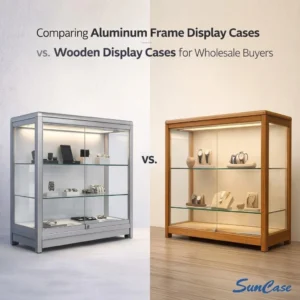
Material choice depends on the use, selling price and handling conditions. Aluminum cases may provide a structured outer shell with frames, panels, hardware and an interior liner. Acrylic can support visibility in a display setting, while cardboard can suit lightweight, lower-cost storage or packaging. Actual constructions vary, so ask for the materials by component.
Compare:
- Alluminio: frame and panel construction, locks, handle, lining and empty weight.
- Acrylic: visibility, thickness, edge finish, closure and resistance to scratches or cracking.
- Cardboard: board grade, construction, closure, print finish and intended reuse.
Do not assume an aluminum case is fully metal or that its material label proves impact protection. SUNCASE’s listed display-case page identifies aluminum, ABS panel and acrylic panel in the construction. Confirm which material forms each part and whether the selected version has a transparent front, interior dividers or another layout. For damage or security claims, request specific evidence for the model and configuration.

How Should Buyers Confirm Capacity and Sizing?
Capacity figures only help when the item format is defined. A “120-card” case may refer to a specified holder size or arrangement, and a listing’s number should be checked with the actual slabs your customers use. Slab thickness, label area, protective sleeves and dividers can change how many holders fit comfortably.
Measure representative holders from the target customer base. Check usable interior dimensions, slot spacing, insertion and removal, and whether the lid closes without pressing on labels or holder corners. If the case is intended for more than one grading brand, test each holder type separately and record fit by model or version.
Before production, compare a dimensioned drawing with a physical sample. Clarify whether dimensions are external or internal and whether the stated capacity assumes bare holders or sleeves. Avoid describing a case as universal unless compatibility has been checked across the formats you plan to name.
What Affects MOQ and Wholesale Pricing by Case Type?
Wholesale pricing depends on more than the case material. Size, interior layout, hardware, finish, logo method, packaging, quantity and shipping terms can all change the quotation. Tooling or a custom insert may add setup cost, while a standard configuration may use different terms from a custom trading card case.
Ask suppliers to quote the exact SKU and configuration at your planned order quantities. Confirm MOQ, sample availability and cost, production schedule, packaging, payment terms, Incoterm and destination. For a repeat order, identify which features must remain consistent and how revisions will be controlled. Current timing and price need to be confirmed in the quotation, not inferred from another product page.
SUNCASE’s listed card models show distinct constructions and dimensions, and their product pages include model-specific MOQ information. Treat those details as belonging to the relevant SKU only. A buyer sourcing more than one trading card case should request a separate line item for each format and customization level.
Which OEM Options Help Trading Card Retailers Build a Brand?
Branding can help retailers distinguish a product line, but the right option depends on the case surface, design and order quantity. Potential items to discuss include a logo plate, printing, color, interior labeling, packaging or a layout tailored to specific holders. Confirm which options are available for the selected model and what they add to MOQ, cost and lead time.
SUNCASE describes OEM/ODM projects that may begin with a drawing, sample or functional brief and include sample feedback before production. For a branded graded card case, provide logo artwork, preferred placement, case dimensions, holder type and capacity target. Request a marked-up proof or physical sample and approve it before authorizing the bulk order. Confirm artwork, tooling and intellectual-property terms in writing.
FAQ
1. How many graded cards should a wholesale case hold?
Choose capacity based on customer use and holder format. Confirm the stated number by loading actual slabs and checking that the case closes without crowding or pressure.
2. Will a PSA slab case fit BGS holders?
Not necessarily. Holder dimensions can vary. Check the product’s documented compatibility and test representative PSA and BGS holders before making a multi-brand claim.
3. What is the difference between a PSA card case and a trading card storage box?
A PSA card case usually refers to storage for graded holders, while a trading card storage box may be intended for raw cards, sleeves or bulk sorting. Confirm the intended payload and internal layout.
4. How do I choose a sports card case for retail?
Consider whether customers need transport, display or storage; then match material, capacity, holder fit, closure, finish and price point to your channel. Keep compatibility details visible in product information.
5.What should I ask a trading card case supplier before ordering?
Ask for dimensions, materials by component, holder compatibility, tested capacity, MOQ, sample terms, branding options, packaging, inspection criteria, lead time and shipping terms for the selected SKU.
Build an Assortment Around Verified Fit
A wholesale trading card case range works best when each product has a clear job: display, transport or storage. Confirm holder compatibility and capacity using real slabs, compare materials and packaging against the channel, and agree on branding, MOQ and inspection terms before production. SUNCASE lists several graded-card display and storage formats; send the holder dimensions, quantity, destination and brand requirements to review a specific configuration and current order terms.