
Problèmes de qualité courants dans les mallettes de maquillage avec miroirs éclairés : 7 vérifications que les acheteurs devraient effectuer
Réponse rapide
Common quality problems in a Trousse de maquillage avec miroir lumineux include flickering LEDs, uneven brightness, mirror damage, loose wiring, unreliable power, weak hinges and poor travel protection. Buyers can reduce these risks by checking a production-representative sample, testing the complete lighting system, confirming materials and power details in writing, and agreeing on inspection criteria before mass production. SUNCASE lists several lighted makeup case configurations; confirm the exact model, options and order requirements before sourcing.
What Should Buyers Check Before Ordering a Makeup Case with Lighted Mirror?
UN lighted mirror adds an electrical system and a fragile surface to a case that must also organize and travel with cosmetics. A product can look attractive in a listing but still disappoint if the lights behave inconsistently, the mirror shifts in transit or the trays do not suit the intended products.
This guide covers seven recurring quality risks, how a capable fabricant de trousses de maquillage can help prevent them, and what distributors and procurement teams should verify before approving a sample or bulk order. The checks are practical questions—not claims that every supplier uses the same process or that a sample alone proves long-term performance.
Why Do the LEDs Flicker or Fail to Turn On?
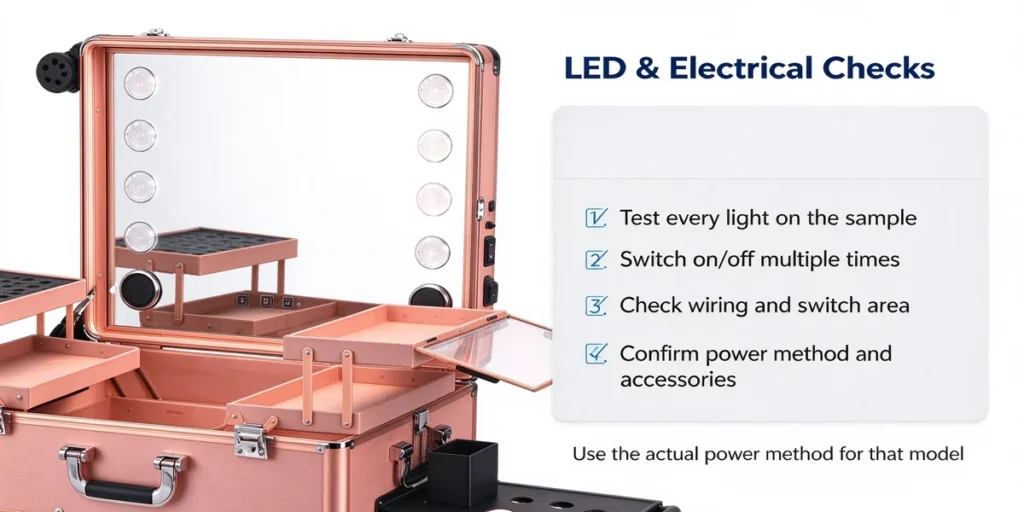
LED flickering can result from an unstable power connection, a loose wire, a poorly secured connector, inconsistent components or a switch that does not make reliable contact. The symptom may appear only when the case is moved, the lid is opened repeatedly or the power source is low.
Ask the supplier to demonstrate the full lighted makeup case with the intended power source. Switch it on and off several times, check every light, and gently move the lid and case while the lights are on. The lights should remain steady during this basic sample check. For repeat orders, agree in advance how lighting operation will be checked and documented on production units.
Confirm the power method—such as batteries, USB input or another configuration—along with any included accessories and operating instructions. Do not assume that a cable, adapter or battery is included just because a product image shows one. For models with multiple brightness or color settings, check every setting on the selected sample.
What Causes Uneven Brightness or Inconsistent Light Color?
LED bulbs around a mirror may vary in brightness or color if components are mixed, installation positions differ, or the bulbs and controls are not checked together. For a makeup case with lights intended for professional use, noticeable differences from one side of the mirror to the other can affect usability and the product’s perceived quality.
Inspect the mirror under the same room conditions and power level. Compare the brightness around the full mirror, look for visibly different color tones, and check whether the settings change consistently. If color temperature or brightness levels are important to your market, write down the expected settings and acceptable variation in the product specification rather than relying on a verbal description.
A cosmetic case manufacturer should be able to confirm which lighting options are available for the exact model. Ask whether the specification is standard or customized, and request approval of the final sample before production. Different versions in a product family may not share the same lighting configuration.
How Can Buyers Reduce Mirror Cracks, Scratches and Movement?
A mirror can be scratched during assembly or handling, crack under pressure, or shift if it is not held securely in the lid. Packaging that leaves the mirror exposed to movement can add risk during storage and shipping. These issues affect both the product’s appearance and whether it can be sold as new.
Review the mirror face, edges, attachment and surrounding lid on a representative sample. Open and close the case several times, then check whether the mirror stays seated and whether the lid holds its position as intended. Ask how the mirror is protected inside the case and in the export package. If the product will travel through multiple distribution stages, confirm the packaging configuration for the actual order.
For a makeup case with mirror and lights, inspect the electrical parts and mirror together. A secure mirror should not pinch wiring, and the wiring should not be exposed where cosmetics or stored tools can snag it. Ask for clear photos or a sample review where the internal attachment is not visible from the product listing.
What Wiring and Switch Problems Should a Buyer Look For?
Loose or poorly routed wires may become pinched when the case closes, catch on stored items or pull away from a connection. A switch may also feel loose or operate inconsistently. These problems can be missed if an inspection checks only whether the lights turn on once.
During sample review, inspect visible wire routing and the switch area. Open and close the lid several times while checking the lights. Make sure normal use does not pull, trap or scrape the wiring. Ask the supplier to state what checks are included in its own inspection plan; do not assume a particular test or acceptance standard unless it is agreed in writing.
Before purchasing, clarify who handles defective electrical components, what evidence is required for a claim and how replacement or corrective actions are handled under the order terms. Warranty and after-sales arrangements vary by supplier and contract, so get them in writing rather than assuming they are included.
How Do Power and Charging Issues Affect a Lighted Makeup Case?
Power-related complaints can stem from unclear instructions, an unsuitable power source, a damaged port or a mismatch between buyer expectations and the actual configuration. If a lighted makeup case uses a rechargeable component, buyers should confirm the stated charging method and included accessories. If it uses replaceable batteries, confirm the type and whether batteries are supplied.
Check the selected unit using the power method specified for that model. Verify that the controls work as described and that any port or battery compartment is accessible without forcing it. Ask for the operating instructions and the exact power details to be included in the approved specification and, where needed, the packaging artwork.
For international distribution, buyers should identify any destination-market documentation or labeling requirements relevant to the electrical components and ask the supplier what model-specific documents are available. Do not infer regulatory compliance from the presence of LEDs, a USB port or a supplier’s general product range. Request the applicable evidence for the exact configuration and destination.
Why Do Hinges, Latches, Handles or Trays Wear Out Early?
The mirror and lighting attract attention, but the case still needs to open, close and carry reliably. Weak hinges, loose fasteners, misaligned latches, uncomfortable handles or trays that bind can reduce the useful life of a vanity case with lights. A case that is overloaded beyond its intended use may also put extra strain on these parts.
Check that the lid opens and closes smoothly and that the latch aligns without excessive force. Inspect handles and hinges for visible looseness, and slide or unfold the trays several times if the model has them. Confirm the intended contents, approximate load and carrying method with the supplier so the selected construction and interior can be reviewed against the buyer’s actual use.
Do not treat a category name or product photo as proof of a load rating or travel-protection level. Ask for dimensions, materials and component details for the selected SKU. Where a performance claim matters—such as impact or load resistance—request the relevant test basis or documentation for that exact product.
How Can Buyers Avoid Poor Fit, Layout and Shipping Damage?
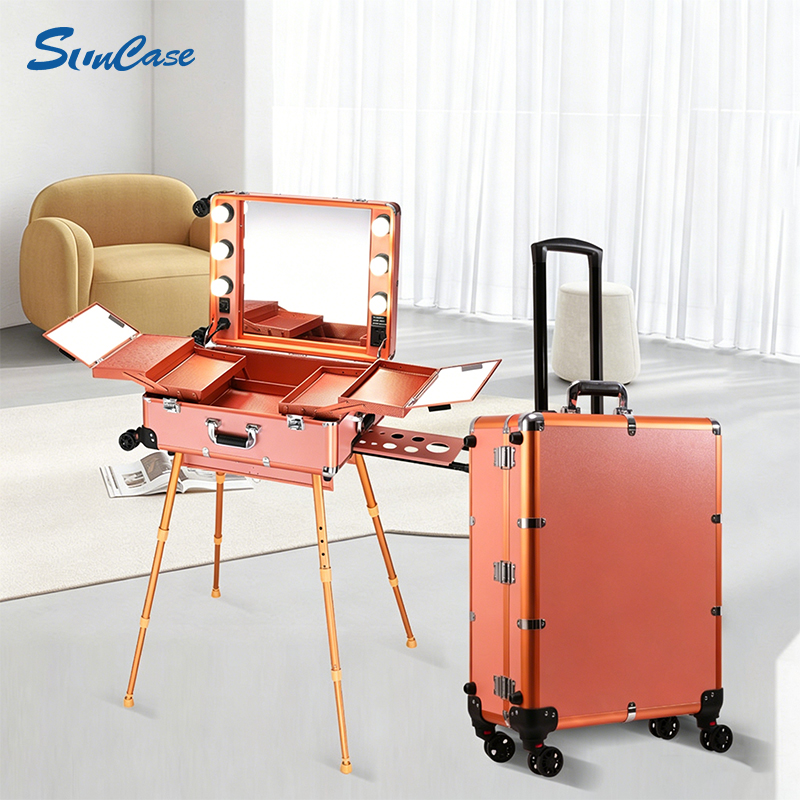
An LED makeup case can have working lights and still be the wrong purchase if bottles do not fit, brushes lack a suitable place, or the case is awkward to carry. Internal dimensions, divider layout and tray movement matter as much as external appearance. Packaging also needs to protect the case and mirror through the intended shipping route.
Before requesting a quote, list the products to be stored, their dimensions and quantity, and how the case will be carried or displayed. Compare those requirements with the usable interior dimensions and layout. Confirm whether dividers, trays, legs, wheels or other features are included in the chosen configuration or are separate options.
The SUNCASE site lists several lighted-mirror formats buyers can review as starting points: the SC-B9018 trolley case is listed at 580 × 460 × 230 mm with an aluminum frame, MDF board, melamine panel and hardware. The SC-B9015 three-color travel case is listed at the same size and with the same material combination. A separate large-capacity case with LED lighting and a Bluetooth speaker appears in the same lighted-mirror category. These are distinct listed products; check the exact page and confirm dimensions, materials, included components and order options before purchase.
How Can a Makeup Case Manufacturer Prevent Repeat Quality Problems?
Prevention starts with a written specification for the exact model and order. It should identify the case dimensions, interior arrangement, mirror and lighting configuration, power method, materials, hardware, packaging and any buyer-specific requirements. The clearer the approved specification, the easier it is to compare a sample with the intended bulk product.
For a new configuration, ask the supplier to confirm feasibility and provide a sample for review where available. Record any changes requested and approve the final version before production. A sample helps buyers review that particular unit; it does not by itself establish long-term reliability, shipment performance or regulatory compliance.
Agree on the inspection scope before production begins. Depending on the order, this may include visual checks for mirror damage, operation of every light and switch, opening and closing the case, interior fit, accessory count and packaging condition. Define any sampling plan, defect categories, acceptance limits and corrective-action process in the purchase documents. These details should be agreed for the order rather than assumed as universal manufacturer practice.
SUNCASE presents an OEM/ODM inquiry path for case projects. Buyers considering a custom makeup case supplier can share drawings or a sample, intended contents, quantities, preferred layout, target market and required documents so the proposed configuration and commercial terms can be reviewed. Confirm MOQ, sample terms, lead time, customization scope and inspection arrangements in the current quotation.
What Should Buyers Put in a Pre-Order Quality Checklist?
Use this short checklist when comparing suppliers or preparing a purchase order:
- Model and fit: SKU, internal and external dimensions, contents, quantity and layout.
- Lighting: bulb count and placement, available settings, expected operation and visual consistency.
- Power: power source, included accessories, instructions and destination-market documentation to confirm.
- Mirror: surface condition, attachment, lid movement and protection in the shipping package.
- Case hardware: hinges, latch, handle, trays, legs or wheels as applicable to the chosen model.
- Materials and options: written confirmation of what is standard, optional or custom for this SKU.
- Quality agreement: sample approval, inspection scope, acceptance criteria, defect handling and records.
- Commercial terms: MOQ, price, sample charges, lead time, packaging and shipping terms confirmed in writing.
This approach helps buyers compare like with like. It also reduces the chance that a discussion about a general product family is mistaken for an agreement on the specific bulk configuration.
Which Makeup Case with Lighted Mirror Is Right for Your Buyers?
The right choice depends on how customers will use and carry the case. A travel-focused buyer may prioritize compact storage and a stand, while a working maquilleur may need a trolley format, larger capacity or a particular mirror setup. Confirm the fit, lighting, power and hardware for the exact model instead of relying on the product title alone.
The main quality risks—flickering LEDs, inconsistent lighting, mirror damage, wiring faults, power confusion and weak case hardware—are manageable when the specification, sample review and inspection criteria are clear. SUNCASE’s listed lighted makeup case options can be a starting point for comparison; buyers should verify each model’s configuration and order terms directly.
Planning a purchase? Send SUNCASE the intended contents and dimensions, order quantity, preferred interior layout, carrying conditions and target-market documentation needs. This gives the team a concrete basis to discuss a suitable configuration and confirm the details that matter before sampling or quotation.
Publications similaires
Guide d'approvisionnement en équipement de salon : Catégories, matériaux et vérifications de gros
8 caractéristiques que les maquilleurs professionnels recherchent dans une trousse de maquillage avec miroir lumineux