
Capacidad del Estuche para Discos de Vinilo: Cómo el Grosor de la Funda Cambia el Número Real de LP
Quick Answer: A 100-LP Rating Is Nominal
A vinyl record case rated for 100 LPs is quoting a nominal capacity, not a guarantee that any 100 records will fit. Real capacity depends on jacket thickness, outer sleeves, gatefolds, lining, dividers and finger clearance. Measure a representative stack, compare it with usable internal width, and verify the count on a packed sample. SUNCASE’s SC-LP0001 lists a 36 × 36 × 36 cm case and a nominal 100-LP rating, but no internal width.
Why Catalog Capacity Is Only a Starting Point
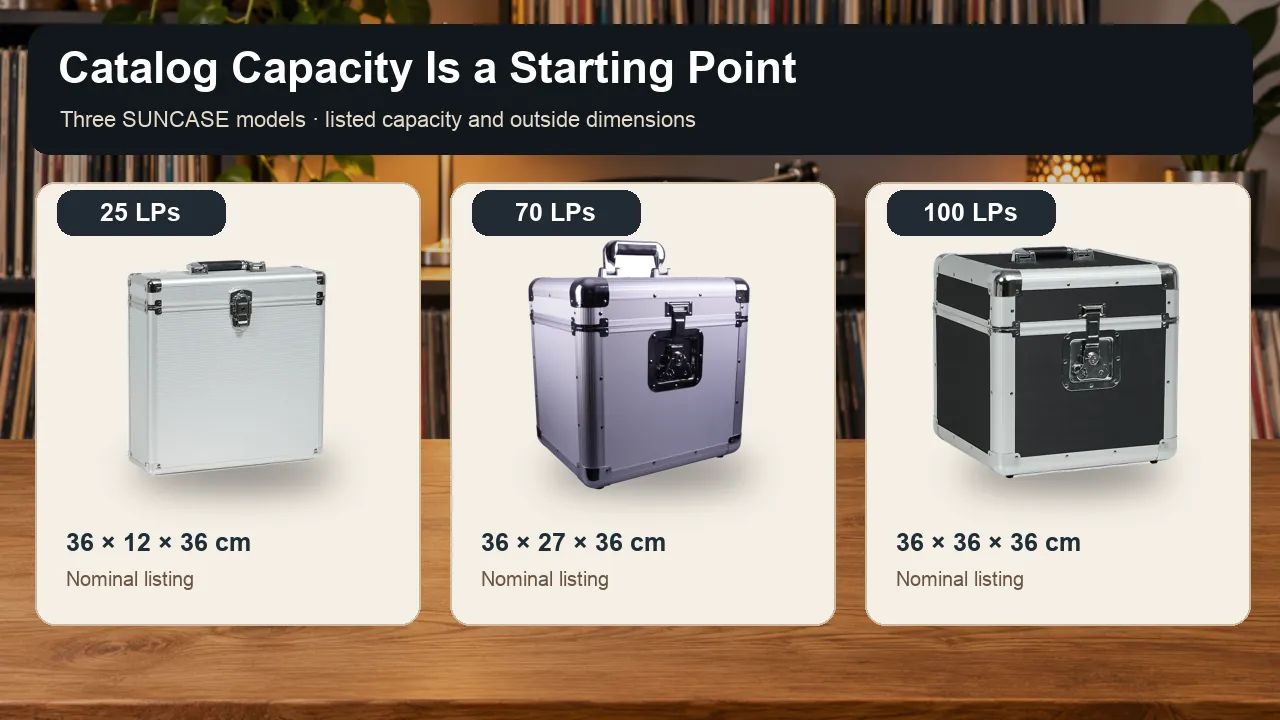
Capacity is a packed measurement. Catalog numbers are planning figures, usually rounded to a convenient model size. They rarely state the jacket mix behind the number, and they are not test certificates.
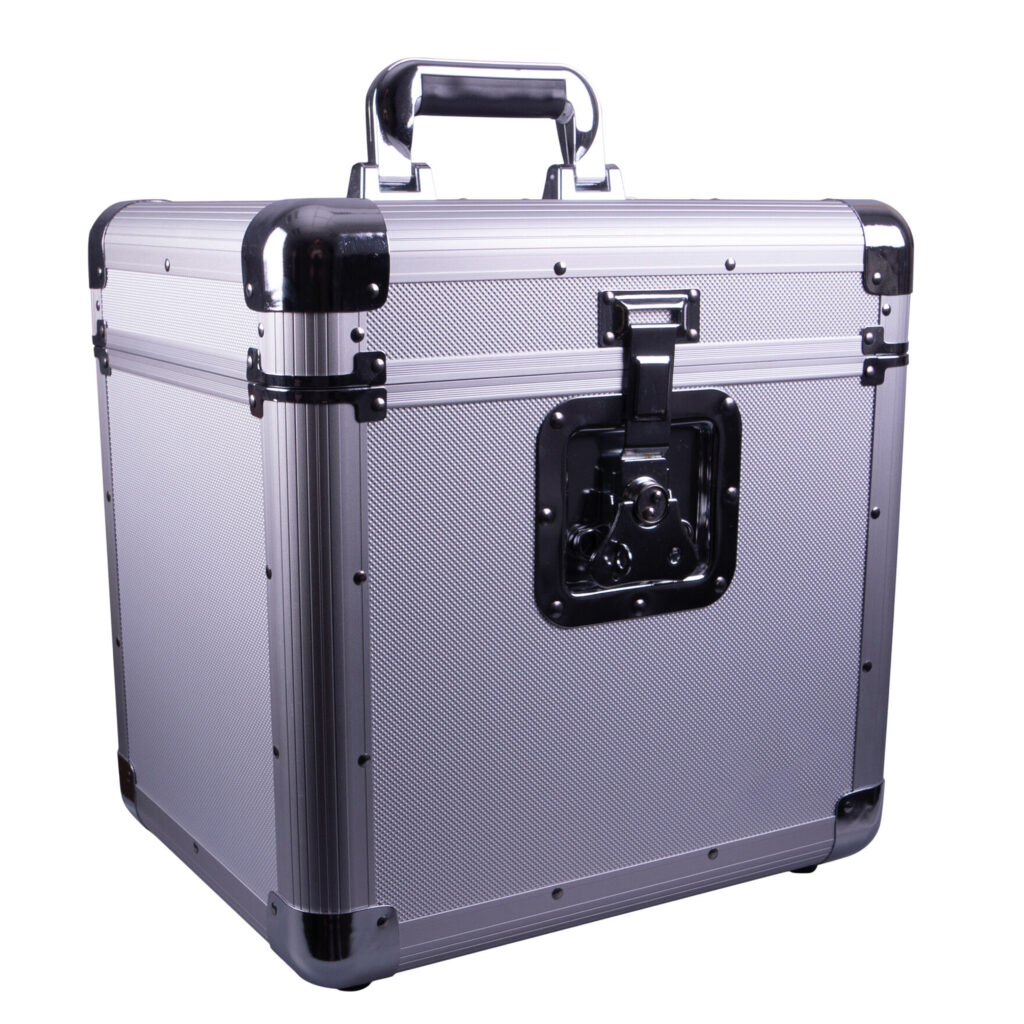
SUNCASE’s SC-LP0001 aluminum vinyl record case is listed at 36 × 36 × 36 cm with a nominal 100 12-inch LP capacity and an MOQ of 100 pcs. Those are external case dimensions, not loading space. A 36 cm cube includes walls, lining, hardware and clearance.
| puede adaptarse mejor a productos mixtos. Si la carga prevista es variada, pruebe paquetes representativos en una muestra. | Page-listed size | Nominal capacity | Cantidad mínima de pedido | What else the page states |
|---|---|---|---|---|
| SC-LP0001 | 36 × 36 × 36 cm | 100 12″ LPs | 100 piezas | Aluminum, ABS panel, EVA foam in the spec block |
| SC-LP0013 | 36 × 27 × 36 cm | 70 12″ LPs | 100 piezas | Fully foam-lined interior compartment |
| SC-B9044 | 36 × 12 × 36 cm | 25 12″ LPs | 100 piezas | 2 kg listed case weight |
The middle dimension rises from 12 to 27 to 36 cm as capacity rises from 25 to 70 to 100, suggesting records load along that axis. It is not a formula, and no listing gives internal width.
SC-LP0001 has a documentation conflict. The spec block says “Aluminum, ABS panel, EVA foam,” while the description says “hard aluminum frame, metal corner, MDF board.” The description mentions a padlock and removable top cover, but the spec block does not. Confirm panel build, lining, lock and lid in writing. The “shockproof” wording has no published test method, so it is not a measured protection rating.

How to Measure Record and Sleeve Thickness
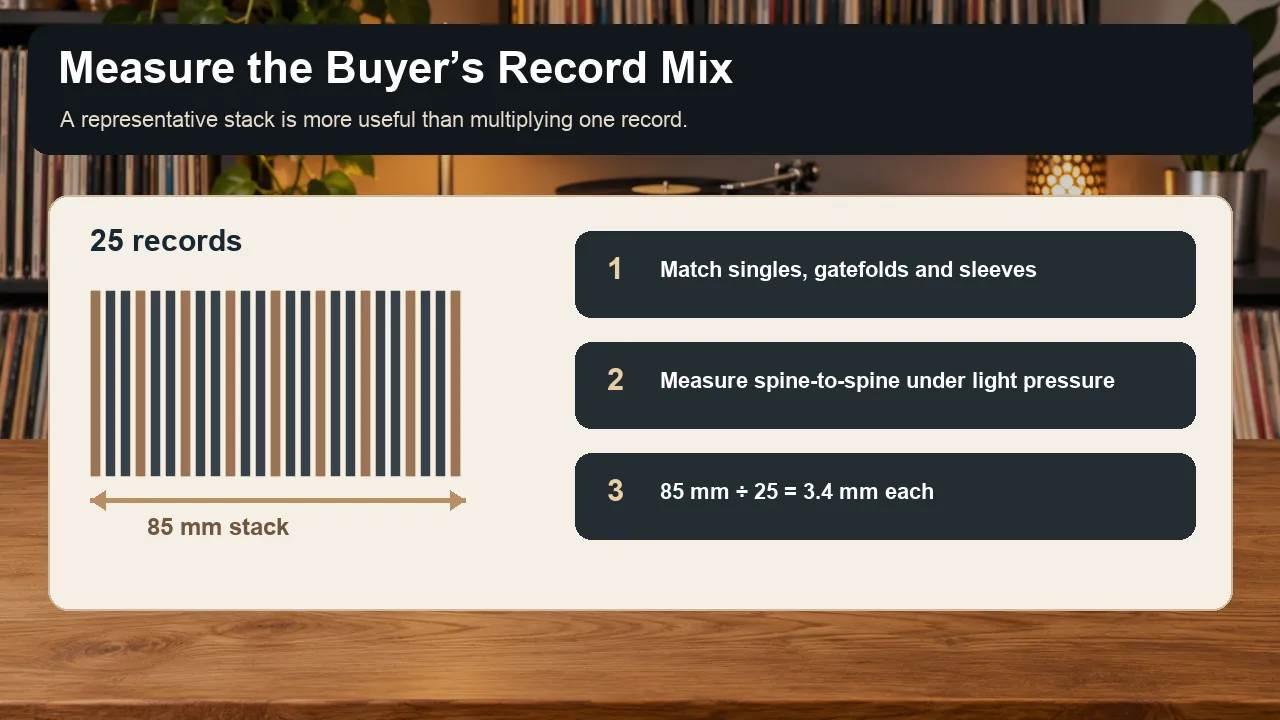
Do not measure one record and multiply. Record thickness alone can range from about 0.9 mm to 2.2 mm, before the jacket and outer sleeve are counted.
- Build a 20–25 record sample matching the buyer’s mix: singles, gatefolds, 2LP sets, box sets and outer sleeves.
- Stand the records upright and measure across the spines with a ruler or caliper.
- Apply light hand pressure only—enough to remove air gaps, not compress the boards.
- Divide the stack width by the record count. For example, 25 records at 85 mm average 3.4 mm each.
- Repeat with two more stacks and use the largest average. For a large order, test a full pack.
That 3.4 mm average is a planning reference, not a standard. A published shelf-capacity study found 100 records stacked to about 34 cm, or roughly 3.4 mm each including sleeves. The same study found a 33.5 cm opening held up to about 90 records, but recommended 70–80 for easy access.
A standard 12-inch LP outer sleeve is commonly 12.75 × 12.75 inches, or 324 × 324 mm. It is larger than the jacket, and the film plus folded seams add width. The 324 mm face also needs clearance in the other two internal dimensions.
Gatefolds, 2LP sets and box sets need their own sample; see the SUNCASE vinyl record case size guide for terminology.
Calculating Usable Internal Width
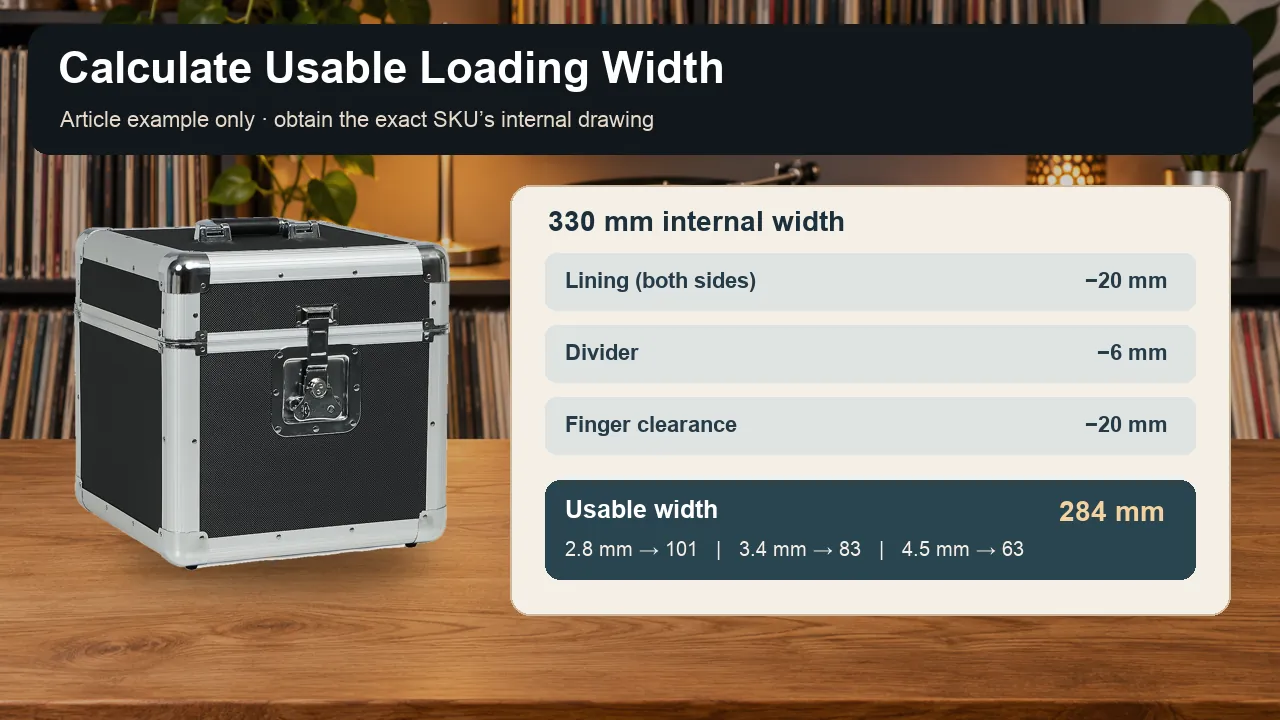
Start with internal width:
Usable loading width = internal width − lining on both sides − divider thickness − finger clearance
Also subtract fixed end padding, hinge intrusion or lid geometry that reduces the opening.
| Step | Ancho |
|---|---|
| Assumed internal width | 330 mm |
| Lining, 10 mm each side | −20 mm |
| One divider | −6 mm |
| Finger clearance at the end | −20 mm |
| Usable loading width | 284 mm |
The table uses 330 mm as an example; substitute the actual internal width from the drawing. At 284 mm, capacity changes quickly:
| Average packed thickness | Approximate capacity |
|---|---|
| 2.8 mm | 101 records |
| 3.4 mm | 83 records |
| 4.5 mm | 63 records |
A 0.6 mm change per record moves the result by nearly 20 records across a 100-record pack.
Ask for internal width and depth on the drawing. Width controls the count; depth and height determine whether the jacket or a 324 mm sleeve fits without bowing.
Space for Dividers and Finger Clearance
Dividers keep records upright and separate genres, but each one consumes width beyond its own thickness because it needs handling space. Specify three things:
- Quantity and thickness. One 6 mm divider is not the same as four 3 mm dividers.
- Fixed or removable. Removable dividers need a slot or track that may intrude into the opening.
- Height and edge finish. A divider taller than the records can catch the lid; a hard edge can scuff sleeves.
Finger clearance lets a user grip a jacket. Without it, the last records jam and users drag sleeves, causing seam splits and corner wear. Start with 20–30 mm at the end of a 12-inch case, confirmed with the end user; this is a working allowance, not a published standard.
Leave a small buffer for future gatefolds or replacement sleeves. Check loaded weight too: 100 records can weigh around 21 kg including sleeves. The handle, hinges, corners and bottom panel carry that load. Review how aluminum carrying cases are built and request a loaded-weight test.
Comparing Sample Packing Counts With Catalog Capacity
A sample pack is the only reliable way to settle the count:
- Use the buyer’s records or an exact mix supplied in writing.
- Record internal width, depth, height, lining thickness and divider thickness.
- Pack in the intended orientation, with the intended outer sleeves.
- Count only what fits with the agreed finger clearance.
- Close the lid without force and confirm it does not press on the records.
- Photograph the pack with a ruler, weigh the loaded case, and ask someone who did not pack it to remove several records.
If the catalog says 100 and the sample holds 88 with the buyer’s mix, quote 88 for that mix. Record the mix, stack width, internal width, divider layout, clearance, packed count, loaded weight and approval signatures.
Settle materials at the same time. For SC-LP0001, ask for a panel build that reconciles the ABS/EVA specification with the MDF description. Confirm lining compression, divider configuration, and whether the padlock and removable top cover are included. Use SUNCASE’s OEM/ODM sample review before bulk production.
Specifying Capacity in an RFQ
Write capacity as a packing specification, not a single number. Include:
- format and count: 12-inch, 10-inch or 7-inch LP
- jacket mix: single, gatefold, 2LP or box set
- outer sleeves: yes or no, and type
- measured stack width and record count
- required internal width and minimum finger gap
- divider quantity, thickness and fixing method
- lining or foam material and thickness
- loaded weight and handling
- case style, lock, handle, feet, color and logo
- quantity, destination, packaging and sample approval
- written internal dimensions and capacity definition
An RFQ clause can state a concrete requirement:
The case must hold 100 12-inch LPs packed in single and gatefold jackets without outer sleeves, with at least 25 mm finger clearance and two removable dividers. Confirm internal width, lining thickness and divider thickness in the drawing. Capacity will be accepted only after a sample is packed with the buyer’s records and approved in writing.
If the jacket mix is unknown, specify a planning mix and a minimum count for the heaviest combination.
For panel and lining background, see what vinyl record cases are made of. For storage layout, see how to store vinyl records in an aluminum case.
Choosing the Right Capacity for Your Collection
The right capacity fits the buyer’s records with normal handling, not the largest number that can be forced in. A 100-LP case may suit single jackets but be tight for gatefolds, 2LP sets and outer sleeves. A 70-LP case may cost more per record but be easier to use; a 25-LP case suits mobile, rental or display use.
SUNCASE’s range gives three starting points: the SC-LP0001 100-LP case, the 70-LP aluminum LP case y el 25-LP compact case. Compare internal width, not external size.
Browse the LP / CD case category for styles. Send your record mix, target count, divider requirement, quantity and destination to contact SUNCASE. The supplier can confirm a stock fit or propose an OEM/ODM sample.
Preguntas frecuentes
How Many 12-Inch Records Fit in a 36 × 36 × 36 cm Case?
There is no universal count from the external size. SUNCASE lists the SC-LP0001 at 36 × 36 × 36 cm with a nominal 100-LP capacity, but not internal width. Real count depends on jacket thickness, sleeves, lining and dividers. Measure a representative stack before treating 100 as a requirement.
Does a Gatefold Jacket Reduce Capacity?
Yes, usually. A gatefold uses two boards and a spine, so it is wider than a single jacket; a 2LP gatefold can be wider again. Pack a sample with the actual gatefold share and clearance.
Do Outer Sleeves Change How Many LPs Fit?
They can. A 12-inch outer sleeve is commonly about 324 mm square, larger than the jacket, and the film plus folded seams add width. It also needs clearance in depth and height. A case that fits a bare jacket may be tight once sleeved.
Should Capacity Be Based on External or Internal Dimensions?
Internal dimensions. External dimensions describe the space the closed case occupies; frame, panels, lining, hinges and lid geometry sit between the outside and the records. Ask for internal width, depth and height on the drawing.
How Much Finger Clearance Should a Record Case Have?
About 20–30 mm at the end of a 12-inch pack, confirmed with the end user. Less clearance makes the last records hard to grip and increases sleeve wear.
Can Dividers Increase or Reduce Capacity?
Dividers usually reduce the record count because each divider and its handling gap consumes width. They improve organization and keep a partial load upright, so the trade-off may be worth it. Specify quantity, thickness and fixing method, then count with the dividers installed.
What Should an RFQ Say About Record Case Capacity?
State the record format, jacket mix, outer-sleeve decision, measured stack width, required internal width, finger clearance, divider layout and loaded weight. Require internal dimensions on the drawing and accept capacity only after a packed sample is approved in writing.