Aluminum Tool Case RFQ: 9 Specifications Buyers Should Send Before Quoting
Respuesta rápida
A complete aluminum tool case RFQ defines nine things: packed tools and weight, external and internal dimensions, construction, interior retention, hardware, finish and branding, commercial terms, packaging, and sample/QC timing. Attach a dimensioned drawing, state units and tolerances, and ask suppliers to list assumptions. SUNCASE’s BL-0020 page lists a 45 × 33 × 15 cm case with a tool panel, EVA dividers and a removable shoulder strap; confirm the size basis in writing.
A request such as “quote 500 aluminum tool cases, 45 × 33 × 15 cm” can produce competitive quotes for different products. Panel stacks, inserts, locks, cartons and Incoterms may differ. This template gives tool case wholesale buyers one response structure for a stock or custom aluminum tool case.
The Nine RFQ Points
| # | RFQ item | What to send |
|---|---|---|
| 1 | Tool inventory and measured payload | Item list, quantity per case, packed size and weight, protrusions, fragile points, accessories and orientation |
| 2 | Case envelope and internal dimensions | External target, required internal size, usable depth, lid/base clearance, weight target, tolerance and units |
| 3 | Shell, frame and panel construction | Frame profile, panel skin/core and thickness, lining, finish, corners and component BOM |
| 4 | Interior organization and retention | Tool panel, pouches/sleeves, EVA dividers, foam specification and cutting, insert fixing and lid clearance |
| 5 | Hardware and carrying method | Latch/lock type and count, operation, hinges, handle, strap, corners, feet and spare parts |
| 6 | Finish and branding | Color standard, logo method, vector artwork, size, placement and proof approval |
| 7 | Quantity and commercial terms | Initial quantity, annual forecast, MOQ by configuration, sample charge, tooling, price basis, Incoterm and payment |
| 8 | Packaging and logistics | Individual protection, master carton data, pallet requirements, marks, destination and port/address |
| 9 | Sample, QC and timing | Pre-production sample, approval checklist, inspection/AQL, test reports, lead time, ship date and change effect |
1. Tool Inventory and Measured Payload
Start with a line-item list, not a case photo. For each tool, record quantity per case, length, width and height at the widest point, packed weight, protrusions, fragile or calibrated areas, accessories and required orientation. Measure the complete packed set when a tool shares space with batteries and a charger; a bare-tool dimension understates space and weight.
Add one group photo and one top view. State which items are fixed and which vary by order; a distributor serving several tool families and a brand owner with a fixed retail set need different RFQs, even with a similar envelope.
Ask the supplier to return a marked payload list and identify which items set case depth.
2. Dimensions and Usable Interior
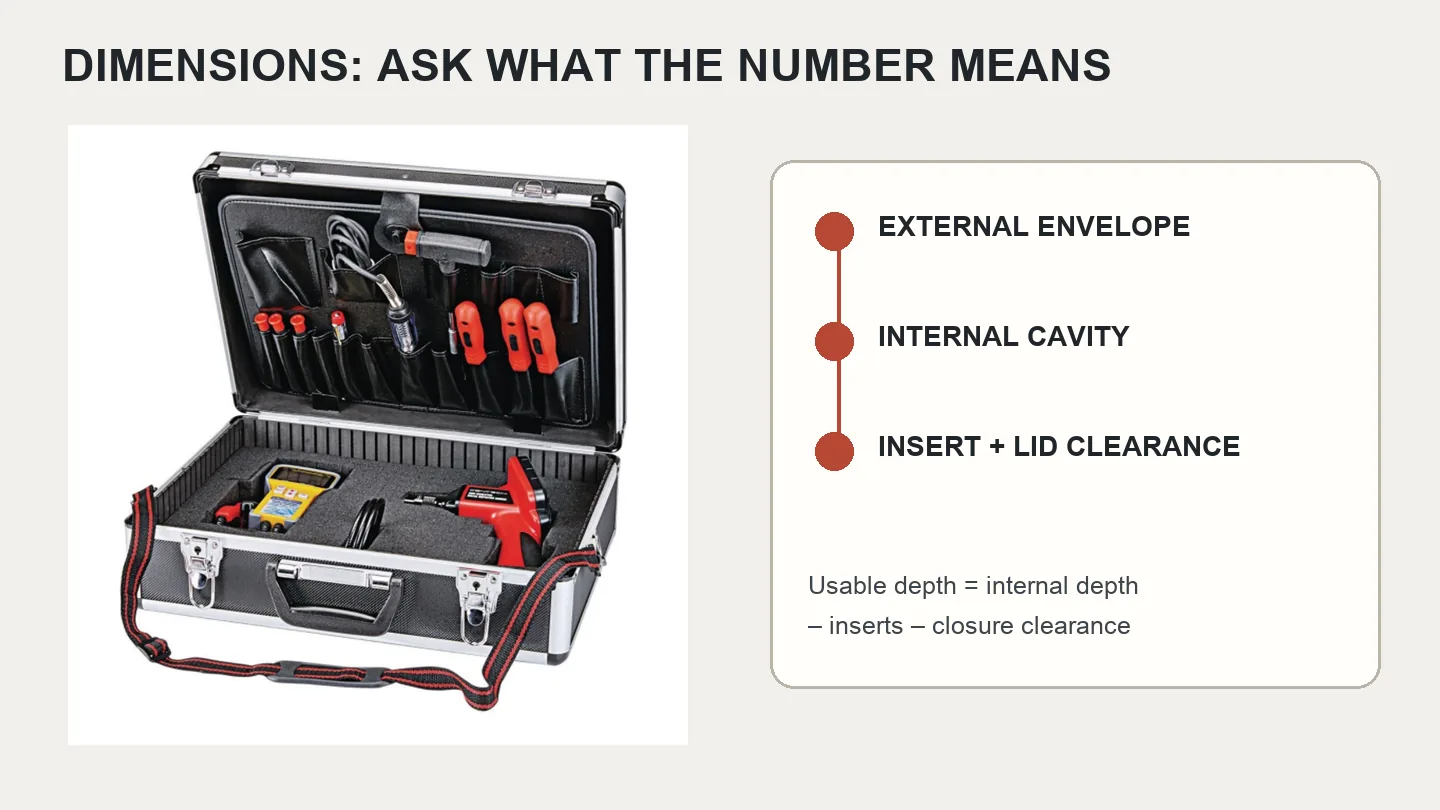
A target external size alone cannot confirm that the contents fit. State the target external envelope, required internal length, width and depth, usable depth after inserts, lid and base clearance, weight target, tolerance and units.
Label every number. “45 × 33 × 15 cm” could mean external dimensions, internal dimensions or a packaging size. The BL-0020 product page lists that size or customize, but it does not label the basis. Ask for a dimensioned drawing that marks the outside, internal cavity, lid depth, base depth and insert thickness.
Use one unit and state the required tolerance rather than assuming a default. Calculate usable depth as internal depth minus base insert, lid insert and closure clearance. That figure, not the catalog depth, is what tools can occupy.
3. Shell, Frame and Panel Construction
An aluminum tool case can describe several builds. Aluminum may be the frame, the skin, a panel reinforcement or a mix. The BL-0020 page lists aluminum, ABS panel, MDF board, EVA/foam/fabric/PU lining and hardware, so “aluminum tool case” should not be read as a hollow aluminum shell.
Ask for a component-level bill of materials by surface: frame profile, panel skin, panel core, panel thickness, lining, finish, corners and fasteners. Ask which parts are visible, load-bearing or replaceable, and make a supplier define “aluminum body” on the drawing.
Construction affects weight, dent resistance, screw retention and loaded handling, and determines whether two quotes are comparable. For how frames, panels and hardware work together, see how aluminum carrying cases are built.
4. Interior Organization and Retention
Send a drawing or clear sketch: tool panel position, pouch and sleeve count, divider count and positions, foam type, density, thickness and cutting, fixed or removable inserts, and lid clearance. State what must stay fixed during carry and what the user removes first.
The BL-0020 page lists an upper lid removable panel with storage pouches and sleeves, an EVA divider storage area and a tool panel with foam. Ask how many dividers are included, whether positions can change, how the tool panel attaches, and whether tools sit under or through the lid panel.
“Foam” may mean polyurethane, EVA, a cut insert or a thin lining pad. Ask for the material, grade, thickness and cutting process. A custom foam insert guide covers the trade-offs; the RFQ still needs the exact stack and cavity drawing.
5. Hardware and Carrying Method
List each hardware item separately: latch type and count, lock type and operation, key or password control, hinge type, handle, shoulder strap, corners, feet and replacement parts. Do not assume casters; they are not listed on the BL-0020 page.
The BL-0020 page lists a removable shoulder strap, a molded carrying handle and quality locking latches with Tools Locks. Ask for the exact quoted latch or lock part, a close-up, the opening method, the number of keys if keyed, and how replacements are supplied. If the quote says “password lock,” confirm whether the user can set or reset it.
Carrying method affects structure: confirm strap attachment points and loaded-weight rating, plus handle grip and mounting, on the sample with the actual payload.
6. Finish and Branding
Give a Pantone, RAL or physical color reference plus the finish and logo method. The BL-0020 page lists metal plate, printed, embossed and laser options. Ask which method suits the artwork and surface, then specify logo size, placement, color and number of positions.
Send vector artwork with fonts outlined or the correct font files, plus a small-size proof. Ask for a digital mock-up and, for a new method, a physical pre-production sample. Approval should cover color, contrast, alignment, edge quality and placement on the actual surface.
Branding can change MOQ, sample charge and lead time, so keep it in the same quotation. Do not approve from a flat PDF alone if the logo will be embossed, printed on a textured panel or applied as a metal plate.
7. Quantity and Commercial Terms
For a tool case wholesale program, state initial order quantity, annual forecast, release schedule and quantity per SKU or configuration. Ask for MOQ by configuration, not one company-wide figure. MOQ may differ for stock colors, standard inserts and no logo versus a custom panel, printed logo and new foam cut.
Request the sample charge and credit terms; tooling cost and ownership; price basis and Incoterm; currency; payment terms; quote validity; and price breaks. The BL-0020 page lists a 100 pcs MOQ, but that figure belongs to its listed configuration. Do not apply it to another model, insert or branding program without written confirmation.
State who owns custom tooling or drawings, and how confidentiality and reuse are handled. A complete commercial section prevents a low unit price from hiding sample, tooling, packaging or freight charges.
8. Packaging and Logistics
Specify how each case is protected: poly bag, foam wrap, corner protection, desiccant, and whether the case ships in its own retail carton. Then state master carton quantity, dimensions and gross weight, pallet pattern, maximum stack, marks and destination. The BL-0020 page lists Guangzhou and Shenzhen ports and EXW, FOB, CIF, DDU and DDP terms, but the quote must state which port, which Incoterm version and what is included.
Give the destination port or final address, because DDP and CIF are not interchangeable. For repeated handling or a demanding route, ask what packaging test or inspection the supplier can provide for the exact case, packaging and route. A protective hard case testing guide explains the difference between a product test and a shipment check.
9. Sample, QC and Timing
Define the pre-production sample, approver, approval scope and deviation record. Check dimensions, insert fit with the actual tools, lid closure, latch operation, handle and strap attachment, color, logo, lining, hardware count and packaging. Photograph the loaded sample and keep the approved revision.
State inspection criteria and AQL, required test reports for the exact configuration, and who pays for testing. Ask for production lead time in working days, its start point (deposit, artwork or sample approval), the ship date and the change-order effect.
The BL-0020 page lists a 7-day sample time and a 15–25 day delivery time, but those figures apply only to that model; get your configuration’s schedule in the quote. SUNCASE’s OEM/ODM process covers design and sample feedback. A sample is useful only when it represents the quoted build.
Before You Request a Quote
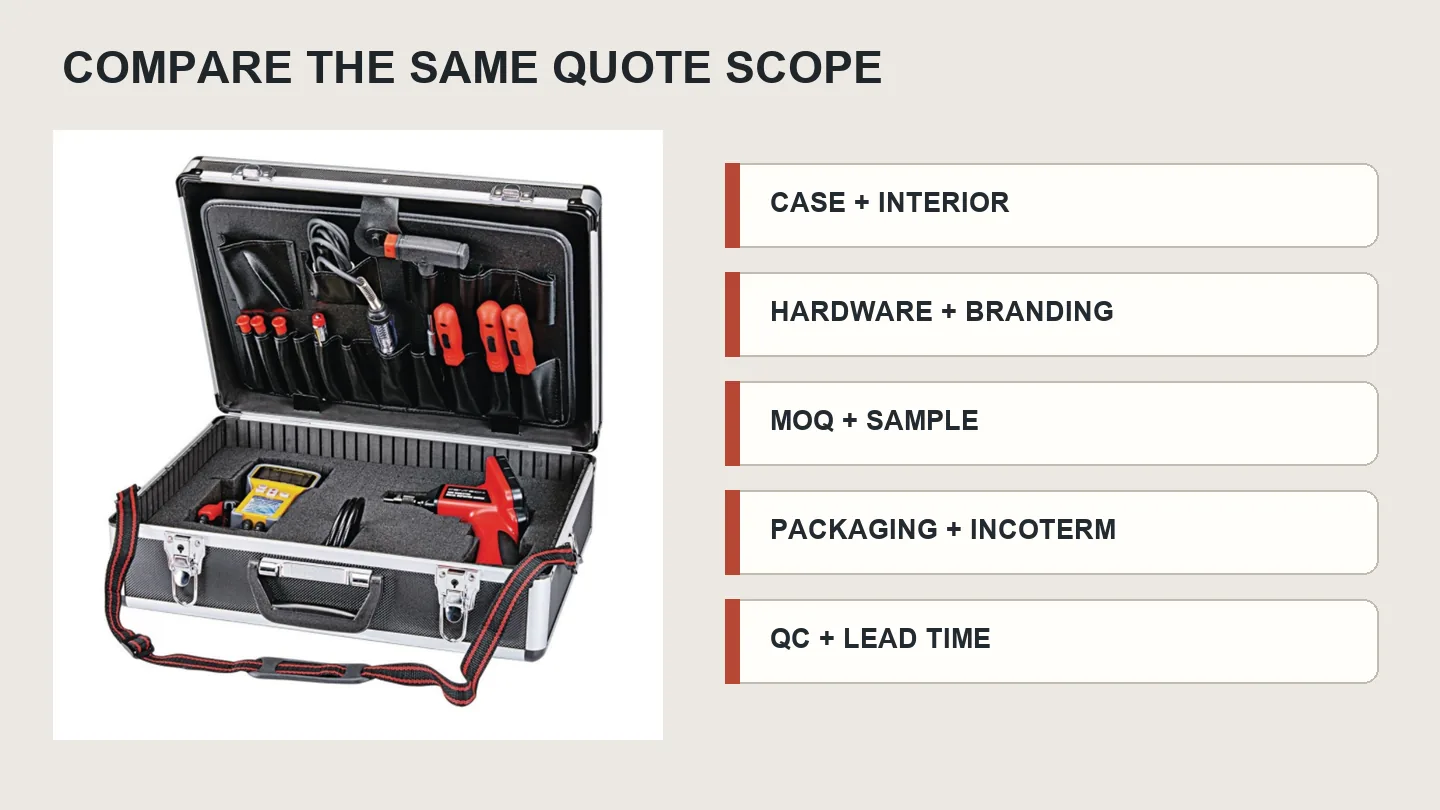
Send the completed table, tool list and dimensioned drawing before asking for a final price. Require the same fields from every supplier and ask each to mark assumptions, then compare specification, not just unit price. Review the BL-0020 aluminum tool case and tool case category, or send a complete custom aluminum tool case RFQ through SUNCASE’s contact page. For background, see aluminum tool case benefits; treat broad claims as context, not specifications.

Preguntas frecuentes
Should I Send External or Internal Dimensions?
Send both. External dimensions describe the closed footprint; internal dimensions describe the cavity before inserts. Add usable depth after inserts, dividers and lid clearance.
Can I Use BL-0020 as a Starting Point?
Yes, as a reference, not a finished specification. The page lists a 45 × 33 × 15 cm size or customize, a tool panel, EVA dividers, a removable shoulder strap and locking latches. Ask which figures are external, what space remains, and how inserts and locks change for your order.
What Lock Details Should the Quote Confirm?
Confirm the exact part, count, material, finish, opening method, key or password control and replacement terms. For “Tools Locks,” request a photo and part specification; a product title is not a lock specification.
How Do I Compare Quotes From Different Suppliers?
Put every response into the same nine-row format. Compare dimensions, insert stack, hardware, branding, MOQ, sample charge, Incoterm, packaging and lead time. A lower price is not comparable if it omits tooling, inserts or cartons.
What MOQ and Lead Time Does BL-0020 List?
The page lists a 100 pcs MOQ, 7-day sample time and 15–25 day delivery time. These apply only to that model, not company-wide promises. Confirm MOQ, sample charge and lead-time start point for your configuration.