
Custom Foam Inserts for Aluminum Cases: How to Choose Density, Cut Method and Layout
Быстрый ответ
Choose custom foam inserts by starting with the item’s dimensions, weight, fragile points and handling conditions—not by selecting a foam density in isolation. Match the foam material and thickness to the required cushioning and fit, then select CNC, die or waterjet cutting according to design complexity and order volume. Check cavity clearance, retention, lid contact and case dimensions on a sample. SUNCASE lists алюминиевые корпуса with pick-and-pluck and foam interiors; verify the exact foam type and configuration for your model.
Why Do Custom Foam Inserts Matter in Aluminum Cases?
An aluminum case provides an outer structure, but the insert determines how equipment sits inside it. A cavity that is too loose lets an item move; one that is too tight can make removal difficult or put pressure on delicate controls. Poor layout can also waste space, complicate packing and increase damage or return risk.
That is why foam inserts for cases should be designed around the actual payload and the way the case will be carried or shipped. A camera, instrument, tool kit and display unit have different weight distributions and fragile points. The right insert is not simply “soft foam”; it is a planned interface between the item and the case.
Before requesting a quote, prepare measured item dimensions, quantity, orientation, accessories, cables and any areas that must not bear pressure. Include the case’s usable internal dimensions and the intended handling conditions. This gives a индивидуальный алюминиевый корпус project a concrete starting point for material, thickness and cavity discussions.
How Should You Choose Foam Material and Density?
Start with the protection need and expected use. Common insert choices can include PE, EVA, polyurethane and other foam materials, but availability and suitability vary by project. Material affects resilience, surface feel, appearance, cleaning and cost. Density describes mass per volume; it is not a simple pass/fail rating for protection. A higher density does not automatically mean better cushioning for every payload.
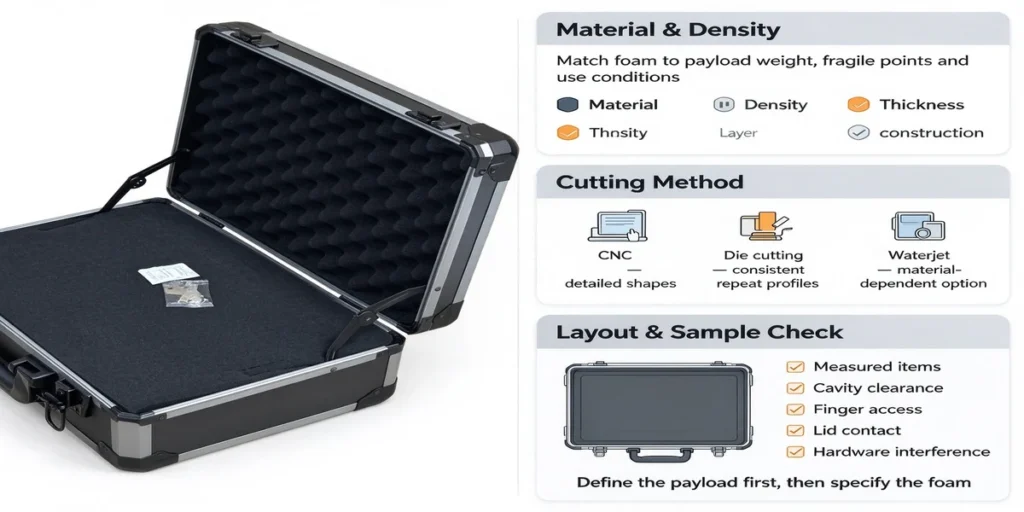
Ask the supplier to identify the specific foam material and density offered for the project, along with thickness and layer construction. Explain item weight and fragile contact points. The design may use different layers or a top layer of softer foam, but the appropriate solution depends on the payload and must be evaluated with a sample or relevant test.
For instruments or equipment with sensitive controls, consider where the insert supports the body and where clearance is needed. Avoid pressure on switches, connectors, lenses or protruding parts. For frequently used tools, balance secure retention with easy access. If cleaning or repeated insertion matters, check the surface and cavity edges in the chosen foam.
SUNCASE lists an aluminum case with pick-and-pluck foam and other aluminum cases with foam. Pick-and-pluck foam lets the user remove pre-scored sections to form cavities, which is convenient for some layouts. It may not suit every precise or repeat-production requirement; confirm foam construction and whether a factory-cut insert is available for the selected SKU.

CNC vs Die Cutting vs Waterjet: Which Method Should You Choose?
The cutting method affects design flexibility, tooling cost, edge finish and repeatability. It should be selected after the layout is understood, because a complex cavity or low-volume prototype may call for a different route than a large repeat order.
When is CNC foam cutting a good fit?
CNC cutting uses a computer-controlled tool to follow programmed paths. It can suit detailed shapes, varied cavities and revisions without a dedicated die for each outline. Ask the supplier about achievable detail, edge finish, minimum radii, tolerances and setup cost for your foam type and thickness. CNC is not automatically the lowest-cost choice for every quantity.
When does die cutting make sense?
Die cutting uses a shaped tool to cut a repeated profile. It can be efficient for consistent designs and larger runs once the cutting die is made. The upfront tooling cost and design changes matter, so compare expected order volume and revision likelihood before choosing it. Clarify who owns the die and how it will be stored or reused.
Should buyers consider waterjet cutting?
Waterjet cutting uses a high-pressure stream to cut material without a conventional blade. It may be useful for certain materials or profiles, but feasibility depends on foam properties, thickness, finish expectations and supplier equipment. Confirm whether the method is actually available for the requested insert rather than assuming all foam suppliers offer it.
Compare methods using the same drawing, foam specification, quantity and tolerance requirements. Ask for a sample cut or production sample where possible, and compare total cost—including setup, tooling, revisions and expected scrap—not only the per-piece quote.
How Do You Design an Effective Foam Insert Layout?
Good layout design is a balance of retention, access and use of space. Begin with an outline of every item and accessory, then locate heavier items where the case can support them and separate parts that may scratch or press against one another. Leave finger access or lift points where users need to remove items.
Specify cavity depth and clearance using the actual item, including handles, knobs, cables and protective covers. Consider lid foam or another closing layer only if it can meet the payload without putting excessive pressure on the contents. Include labels or a silhouette only if they help users repack correctly and are feasible for the chosen method.
Also plan around the aluminum case itself. External dimensions do not equal usable interior dimensions; frame, lining, hinges and hardware reduce available space. Confirm internal measurements at the narrowest points and account for lid depth. SUNCASE’s customized aluminum storage case with foam is one listed product option; use its model specification as a starting point, then confirm the dimensions and foam layout for your payload.
What Foam Insert Design Mistakes Should Buyers Avoid?
Several preventable errors can make a protective case foam insert difficult to use:
- Designing cavities from approximate dimensions rather than measured items.
- Forgetting accessories, cables, covers or future product revisions.
- Placing support under delicate controls, connectors or fragile protrusions.
- Leaving too little finger clearance, making tools hard to remove.
- Using cavities that are too loose, allowing the payload to shift.
- Ignoring the case frame, lid, hinges or lining when calculating usable space.
- Specifying only “high density” without a material, density, thickness and drawing.
- Assuming a marketing phrase such as “shockproof” proves a tested protection level.
To avoid these problems, have the supplier review drawings alongside physical samples or accurate CAD files. If your product changes between production runs, identify the revision and confirm whether the insert needs a matching update. A dimensioned, approved layout makes repeat ordering more reliable.
What Should You Check Before Approving a Production Sample?
Place every intended item into the sample and close the case normally. Check for movement, difficult removal, pressure on fragile areas, contact with the lid and interference from case hardware. Remove and replace items several times to see whether the cavity edges hold their shape and whether the layout works in the real packing sequence.
Measure cavity positions and depths against the approved drawing. Inspect the material, density or grade stated in the specification, cut edges, layer bonding, adhesive and any removable sections. Check that the foam fits the case without bowing the panels or blocking the latch. Record revisions clearly and approve the final sample before production.
If the case will face vibration, drops, repeated handling or a specific environmental condition, define the requirement and ask what test method and report are available for the assembled case and payload. Sample fit alone does not establish impact protection, certification or shipment performance. Agree on inspection scope and acceptance criteria in the order documents.
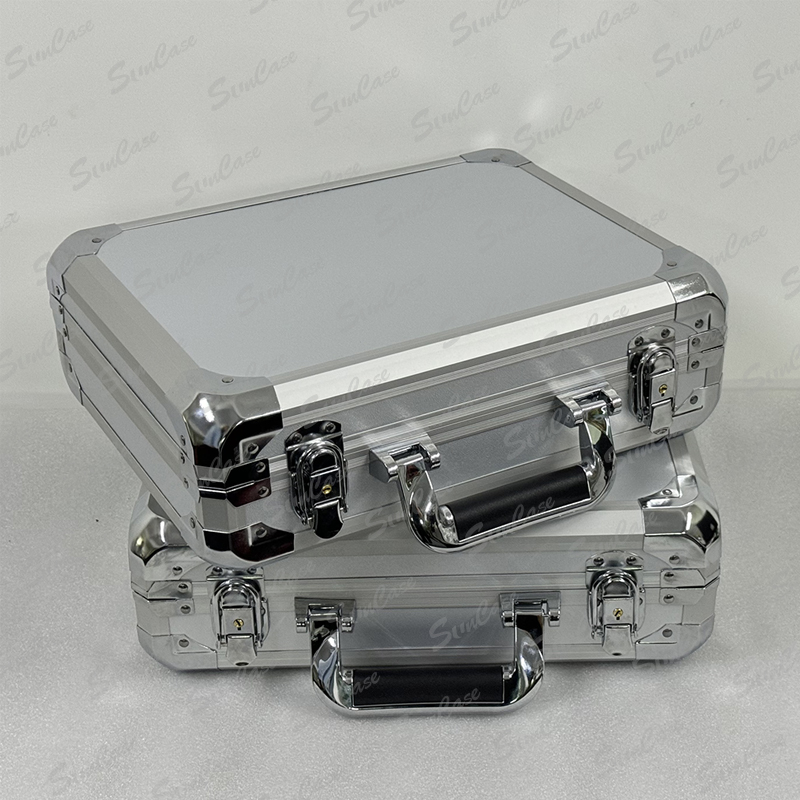
SUNCASE also lists an алюминиевый ящик для инструментов with a foam insert. Its product page describes pick-and-pluck foam for that model. Confirm whether that is the intended option for your order or whether a fixed custom insert is required, then verify the specification, MOQ, sample terms and lead time for the current configuration.
Часто задаваемые вопросы
1. What foam density is best for a case insert?
There is no single best density. Choose based on the foam material, payload weight, fragile points, required compression and handling conditions. Review a sample and request test evidence if a specific protection level is required.
2. Is EVA foam better than pick-and-pluck foam?
They serve different needs. EVA describes a foam material, while pick-and-pluck describes a pre-scored format that users can customize. Compare fit, retention, repeated use, finish and order requirements for the actual payload.
3. Is CNC cutting better than die cutting?
CNC may suit detailed or changing layouts, while die cutting can suit consistent repeat profiles once tooling is justified. Compare setup and tooling costs, quantity, tolerances, finish and revision needs.
4. Can I order custom foam inserts for an existing aluminum box?
Often the supplier can assess a custom insert if you provide accurate usable internal dimensions and a payload layout. Confirm compatibility with the frame, lid, lining and hardware of the exact box.
5. What files should I send for a custom case foam quote?
Provide a dimensioned drawing or CAD file, payload measurements, quantities and orientation, fragile areas, accessory list, case internal dimensions, foam preference if known, and handling conditions. A physical sample can help clarify unclear shapes.
Specify the Payload Before the Foam
Reliable case foam starts with the items it must hold. Define dimensions, weight, fragile points, accessories and handling conditions; then compare material, density, cutting method and layout on a sample. SUNCASE’s listed aluminum cases include foam configurations, including pick-and-pluck options on specific models. Share your drawing or sample and confirm the exact foam, case dimensions, MOQ, sample plan and inspection terms before production.