Guia de Malas de Maquiagem com Rodas para Atacado: Tamanhos, Recursos e MOQ para Distribuidores
Quick Answer:
A useful rolling makeup case RFQ defines the end user, product load, internal dimensions, wheel and handle needs, materials, branding, quantity and inspection plan. Distributors should compare total landed cost and sample fit rather than unit price alone. A makeup train case with wheels can reduce carrying effort for larger kits, but its packed size, loaded weight and configuration still need review. Sun Case lists trolley makeup case formats; confirm model-specific features, MOQ and production timing in a current quotation.
For a distributor, a professional rolling makeup case is a product decision and a sourcing decision. A case that fits the intended kit, moves smoothly and arrives packed to specification is easier to sell and support. This guide shows what to define before requesting prices, which features to compare and how to approve a sample before a wholesale order.
What Should a Rolling Makeup Case RFQ Include?
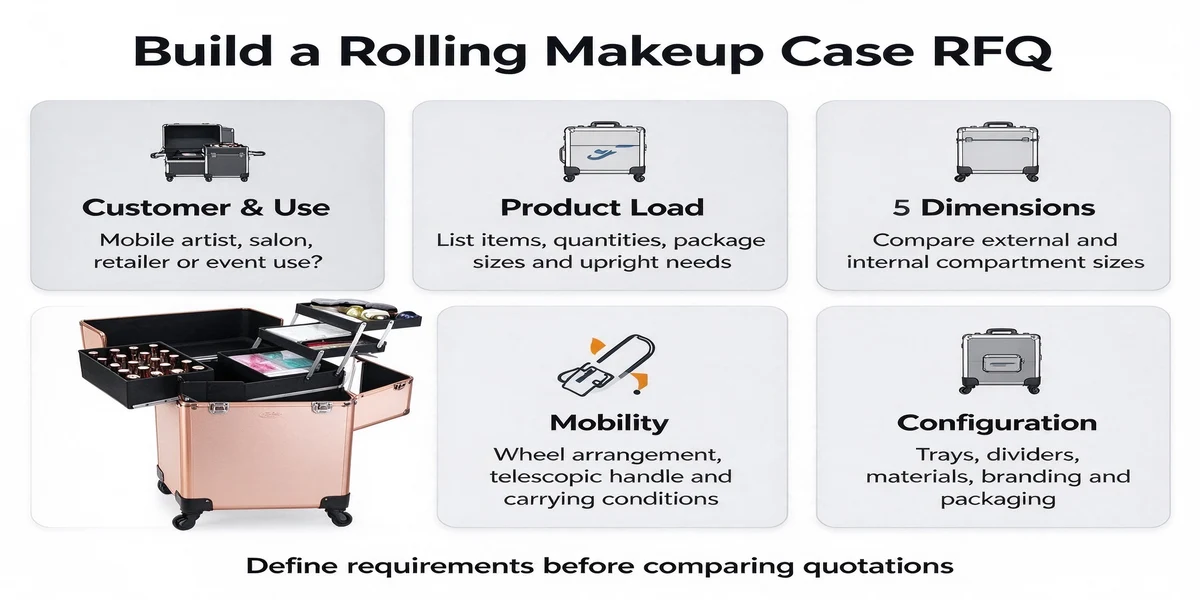
An RFQ (request for quotation) should give suppliers a comparable brief. Start with the intended customer, use scenario, product load, target quantity, destination and requested delivery window. Then list dimensions, materials, wheel and handle expectations, organization features, branding and packaging. Attach drawings or photos where available, and identify which details are required versus preferences.
Ask suppliers to separate standard features from optional upgrades. Request a line-item quote that identifies model, configuration, sample charges, MOQ (minimum order quantity), production timing, packing assumptions and shipping terms. Confirm whether the quoted price includes accessories, logo application and retail packaging.
How Should Buyers Define the Target Customer and Use Scenario?
A case for a mobile artist may need to move between locations and open into an accessible workstation. A salon might keep it mostly in one place, while a retailer may care about carton size, price tier and shelf appeal. Event or training use may involve frequent setup, transport and shared handling.
Describe where the case will travel, how often it will be moved, who carries it and what products it must hold. This helps suppliers recommend a format without assuming that every customer needs the same professional makeup case. Define the user first; features follow from the job.
What Case Size, Internal Dimensions and Load Should Be Specified?
External dimensions matter for freight, storage and fit in vehicles. Internal dimensions determine whether the cosmetics and tools fit. Ask for both, including dimensions for trays and compartments. Record product height, width and depth with caps, pumps and protective packaging included. Mark any products that need to remain upright or separate from others.
Estimate loaded weight using the actual contents. A maleta de maquiagem with wheels still needs to be lifted into a car, onto a curb or through a doorway. Consider the weight of the case itself alongside the kit, and avoid relying on a generic capacity statement. Approve the layout with representative products in the sample.
Which Rolling Makeup Case Configuration Fits the Assortment?
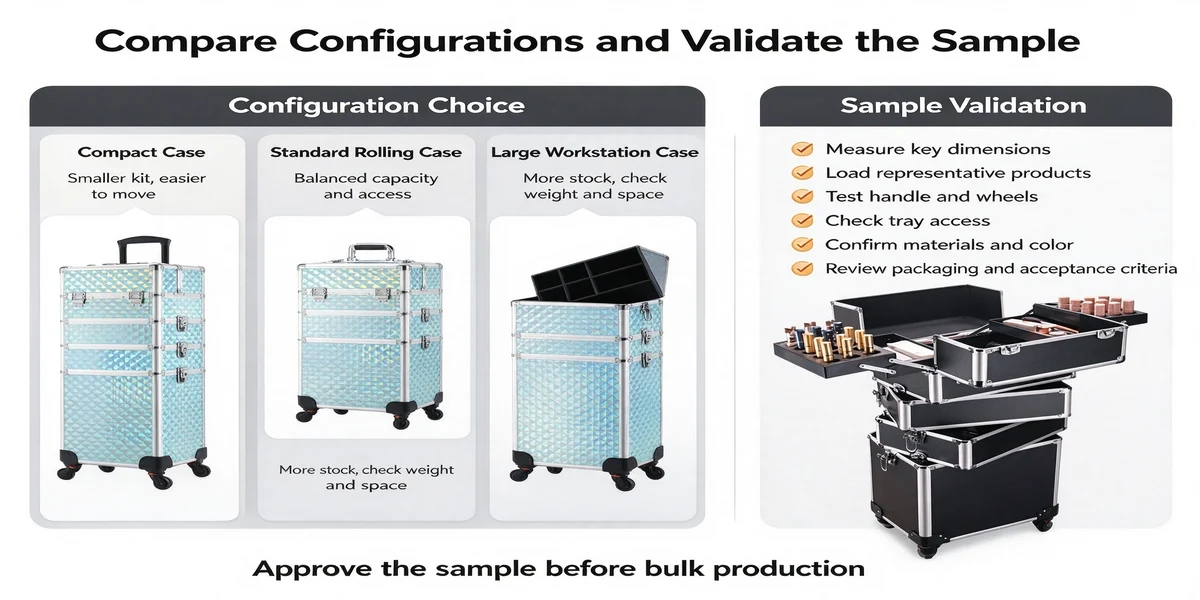
Configurations may vary in number of compartments, tray arrangement, main-body capacity and opening style. A compact case can suit a smaller kit or limited product range. A larger rolling format can consolidate more items but may become bulky in tight workspaces or transport. Compare one large case with a modular approach if buyers need to separate daily-use items from backup inventory.
Look at setup and access. Can a user reach common items without unpacking the entire case? Do trays stay in position when opened? Does the lid or frame obstruct the workspace? A makeup case organizer should support the working sequence, not just maximize the number of compartments.
What Wheel and Telescopic Handle Requirements Matter?
Rodas and a telescopic handle make rolling easier on suitable surfaces, but performance depends on construction, case weight and route. Describe whether the case will move across smooth floors, pavement, thresholds or event venues. Ask what wheel arrangement is available and whether a locking feature is included on the selected model.
On the sample, extend and retract the handle several times. Check for sticking, wobble and secure locking at each position. Roll the case with a representative load; listen for unusual noise, check tracking and test turns. Lift it using the intended handgrips to see whether it remains manageable when stairs or rough ground require carrying.

How Should Shell, Frame, Hardware and Interior Materials Be Compared?
Ask for materials by component. A product described as aluminum may combine an aluminum frame with panels made from MDF, ABS or another material. Hardware, lining and corner construction also vary. Compare the case’s empty weight, surface care, finish, expected use and cost rather than treating one material label as a full specification.
Inspect hinges, latches, handles, fasteners and tray supports. Check whether surfaces are easy to wipe and whether interior dividers can be adjusted or removed. If a mirror, light or other accessory is included, confirm its exact configuration, power method and any destination-market documentation required for your market.
Which Organization Features Can Reduce Damage and Returns?
Separate products that may leak, scratch or press against each other. Use compartment sizes that suit the actual packages, and leave room to take products out. Brushes, palettes, bottles and tools may need different forms of retention. Removable dividers can increase flexibility, while fixed layouts may make restocking simpler.
For an e-commerce assortment, clear product information should explain dimensions, included accessories and intended use. For professional buyers, a sample filled with their representative kit can expose layout issues before purchase. Avoid promising that a case fits a particular set of products unless you have confirmed the dimensions and configuration.
What OEM and Private-Label Requirements Should Be Added?
Private-label requests can include logo placement, color, labels, packaging or interior changes. Specify the artwork file, color reference, placement and size. Ask whether the request changes tooling, MOQ, price or production timing. For a logo plate or printed mark, approve a proof or sample that shows the final appearance.
Sun Case’s trolley makeup case category is a starting point for reviewing listed formats. The site describes OEM/ODM projects based on drawings, samples or functional requirements. Share your target assortment, branding and quantity to discuss feasibility, then confirm the approved scope and commercial terms in writing.
How Do MOQ, Sample Approval and Order Quantity Affect Planning?
MOQ may depend on model, material, branding and packaging. Request prices at more than one realistic quantity if you are planning a launch and replenishment. Check whether a sample is available, what it costs and whether any sample charge is credited against a later order. Confirm the current production schedule and the events that begin the lead-time period.

Plan the order around sell-through and storage capacity, not just a lower unit price at a larger quantity. Include freight, duties, packaging and likely handling costs in the landed-cost comparison. A small initial order may be appropriate for demand validation; a repeat order can follow once fit and sell-through are understood.
What Should Buyers Check on a Pre-Production Sample?
Review the sample against the written RFQ. Measure key dimensions, load the intended products, open the case fully and check access to trays. Test handle extension, wheel movement, latches, hinges and handles. Confirm materials, color, logo, accessories and packaging. Photograph any approved layout and record any changes required.
Before bulk production, agree inspection points and acceptance criteria. These could include dimensions, operation, finish, accessory count and carton condition. If an electrical feature is included, define the checks and documents required for the exact product and destination. A sample review does not prove every unit will match, so include a production inspection plan where appropriate.
Rolling Makeup Case RFQ Checklist
- Target customer, use location and transport conditions.
- Product list, package dimensions, quantities and expected loaded weight.
- External and internal dimensions, including compartment measurements.
- Configuration, tray access, dividers and required accessories.
- Wheel type, telescopic handle and carrying requirements.
- Materials by component, finish, color and care expectations.
- Logo, labels and packaging artwork.
- Quantity, destination, MOQ, sample terms and production schedule.
- Inspection scope, acceptance criteria and shipping terms.
FAQ: Buying Rolling Makeup Cases Wholesale
1. What is the difference between a trolley makeup case and a makeup train case with wheels?
The terms can overlap in product listings. Check the actual structure, size, trays, wheels and handle rather than choosing by name alone.
2. How do I choose a professional rolling makeup case for distributors?
Match the format to the customer and product load, then compare loaded weight, access, materials, branding, MOQ and landed cost. Approve a sample with representative products.
3. What is a reasonable MOQ for a makeup case wholesale order?
There is no universal MOQ. It depends on model, customization, materials and packaging. Request the current MOQ for each configuration and quantity tier.
4. Should rolling makeup cases have locking wheels?
That depends on use and availability for the selected model. If stability matters at the point of use, request the feature explicitly and test it on the sample.
Build the RFQ Around the User and Load
A strong rolling makeup case wholesale purchase starts with a clear use scenario and product load. Specify dimensions, organization, wheels, materials and branding, then verify them in a representative sample. Sun Case lists trolley formats for comparison; send the product list, quantity, destination and brand requirements to review a suitable configuration and current order terms.