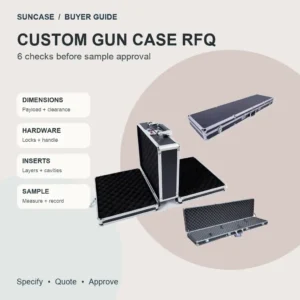
Rifle Case Size Guide: How to Measure Overall Length and Interior Clearance
Quick Answer: What Size Rifle Case Do You Need?
Measure the rifle as it will be stored, including the muzzle device, extended stock, optic, bipod and sling hardware. Add working clearance at both ends and above the tallest point, then compare that figure with usable internal length, width and depth—not the catalog size. SUNCASE’s Z22 page lists a 150 × 35 × 12 cm case, but publishes no internal dimensions and does not label the basis. Confirm the interior drawing before ordering.
Measure the Rifle as a Stored Package
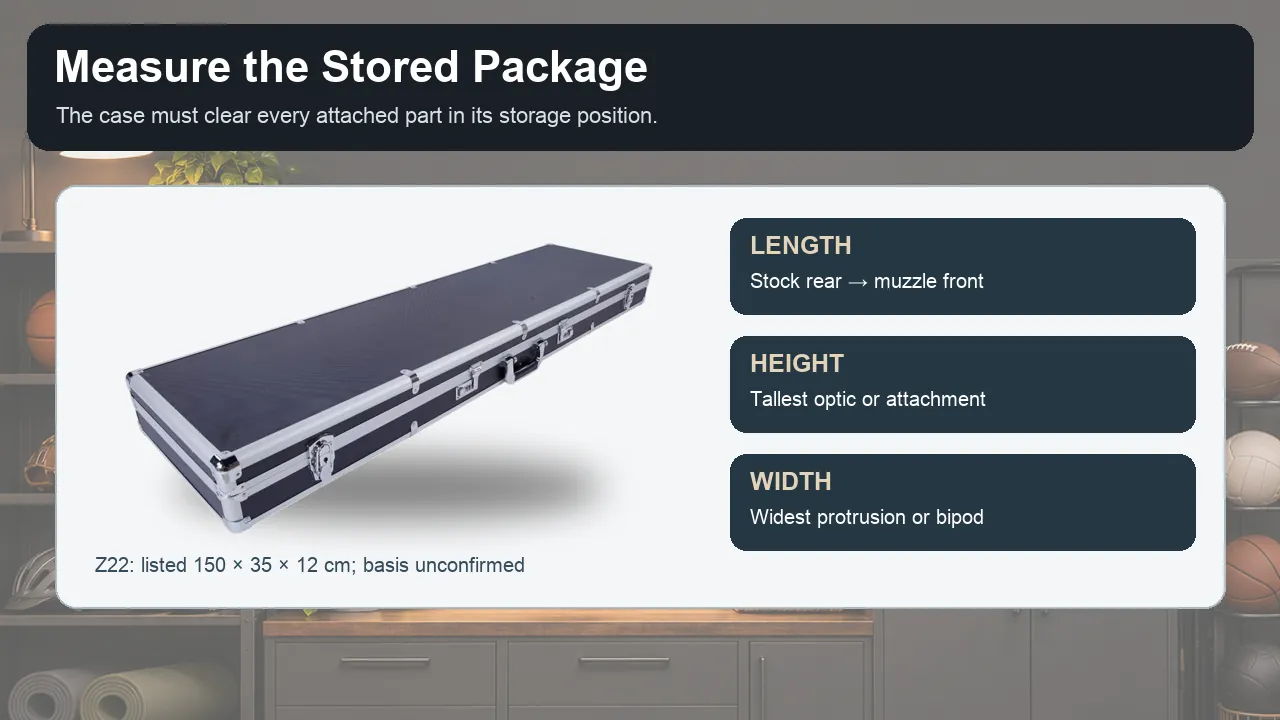
Measure the rifle as a package, with every attached part installed; the case must accept it without forcing the lid closed.
What Counts in Overall Length?
Overall length runs from the rear of the stock to the muzzle. A recoil pad, sling stud, muzzle brake, thread protector or suppressor changes that figure. Measure the complete assembly in the position the case must accept, in one unit. If the rifle folds, measure folded and open lengths; if the stock adjusts, use its longest setting.
Which Attachments Change the Footprint?
Length is the first filter, not the whole footprint. These parts commonly decide whether a rifle fits a long gun case:
| Part | What to measure | なぜ重要なのか |
|---|---|---|
| Optic | height, objective bell diameter, turret width | lid and side foam must clear the tallest and widest points |
| Bipod | folded and deployed width and depth | a folded bipod can still be wider than the rifle |
| Suppressor or muzzle brake | added length and diameter | the muzzle needs length and width clearance |
| Sling and swivels | protrusions from stock and fore-end | small hardware can catch on foam |
| Magazine and bolt handle | side profile | either can increase required width |
Calculate Usable Interior Clearance
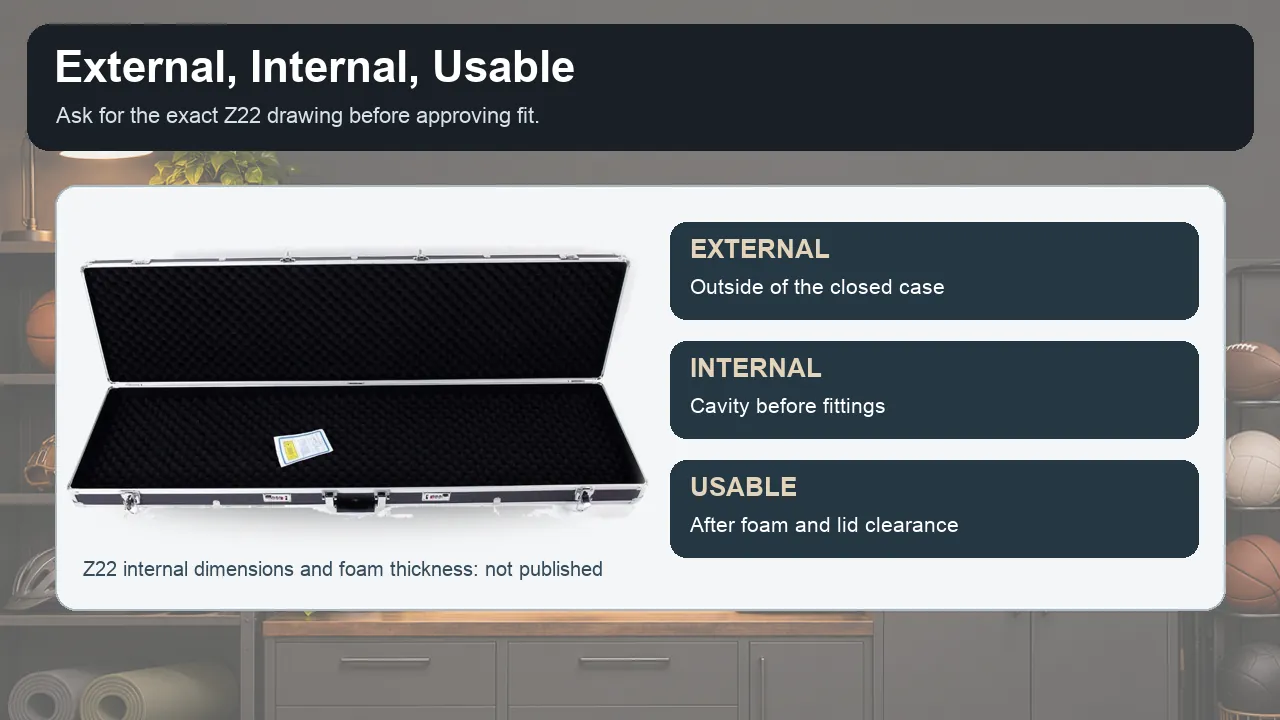
Catalog dimensions are not the space available to the rifle; walls, lining, foam and the lid consume volume.
What Is the Difference Between External, Internal and Usable Dimensions?
| 寸法 | What it describes | Useful for | What it does not tell you |
|---|---|---|---|
| External | the outside of the closed case | vehicle, shelf, pallet and shipping footprint | whether the rifle fits |
| Internal | the cavity before interior fittings | the starting point for fit planning | space left after foam or inserts |
| Usable | what remains after foam, dividers and lid clearance | rifle fit | weight, protection or transport compliance |
How Do You Allow for Foam and Lid Depth?
Usable length = internal length − end foam or wall padding − any hard divider.
Usable depth = base depth + lid depth − base foam − lid foam − closure clearance.
Compressed foam puts extra load on the latches; the insert should retain the rifle without forcing the case shut.
The Z22 page does not publish foam type or thickness. The Z25 double case, used only as a layout example, lists convoluted lid foam and two removable base layers. Request a Z22 cross-section; the best foam for aluminum gun cases guide compares insert types.
Check the Z22 Size Listing
SUNCASE’s Z22 rifle case page lists 150 × 35 × 12 cm. The page does not say whether that is external or internal, and it publishes no internal dimensions, usable length or foam thickness. Treat it as an envelope to investigate.
The title also uses a 53-inch label—about 135 cm, while 150 cm is about 59 inches, a difference of roughly 15 cm. The page does not explain the difference; ask what the 53-inch label measures.

Account for Optics and Accessories
How Do You Measure an Optic’s Height and Width?
Measure from the lowest point of the rifle at the optic’s location to the highest point, including turrets and lens caps. Then measure the widest point, often the objective bell or mount. Tube diameter is not the height. If the optic is offset, include that in the width; the lid must clear the turret and mount, not just the tube.
What About Bipods, Suppressors and Sling Hardware?
A bipod can be wider folded than the stock. Measure it stored, and deployed if the case is meant to hold the rifle ready to use. A suppressor adds length and diameter at the muzzle; a brake adds length. Sling swivels, flush cups, bolt handles and magazines also count; measure the side profile with them installed.
Define the storage configuration before the foam is cut; the custom foam inserts guide explains how cutouts and layers are planned.
Choose a Single or Double Layout
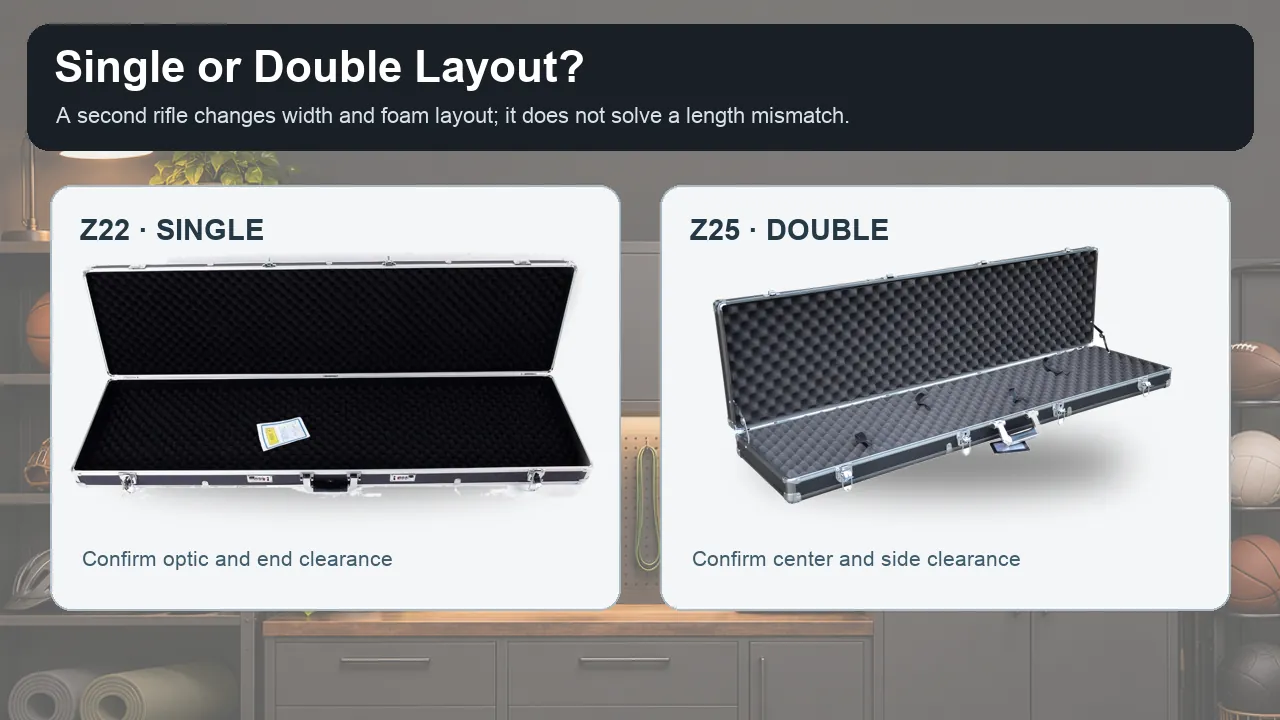
Layout changes width, foam and balance, not just capacity.
| Layout | 最適 | Space effect | Confirm |
|---|---|---|---|
| Single rifle | one scoped rifle with a small accessory set | narrower interior, simpler foam cut | internal length, optic height, end clearance |
| Double, side by side | two rifles with shared accessories | greater width and two cutouts | center wall, total width, optic-to-optic clearance |
| Double, opposing | two rifles in a shorter envelope | length may be shared, hardware may conflict | bolt handles, muzzles, stocks, center padding |
SUNCASE’s Z25 double rifle case lists 1334 × 346 × 114 mm, with convoluted lid foam and two removable base layers. Use that only to understand double-case proportions; do not transfer its dimensions or terms to the Z22. The hard versus soft rifle case comparison covers the shell trade-offs. A double case is usually wider, not longer; it does not solve a length problem.

Confirm Fit-Critical Details in Writing
Put fit-critical dimensions in the quotation and purchase order.
| アイテム | なぜ重要なのか | What the Z22 page shows |
|---|---|---|
| External dimensions | vehicle, shelf and shipping footprint | 150 × 35 × 12 cm listed; basis not labeled |
| Internal dimensions | starting space for the rifle | not published |
| Usable length and depth | fit after foam and lid structure | not published |
| Lid and base depth | optic and accessory clearance | not published as a split |
| Foam type and thickness | fit, retention, replacement planning | not published |
| Lock type | operation and spare-key planning | description says combination; title and image alt text mention keys |
| Actual weight | carry and carrier limits | “usually 5–10 kg,” not model-specific |
| Ingress wording | catalog and product claims | “waterproof and dustproof” without a test report |
The description says “certified locks” and “high-security combination locks,” while the title and image alt text mention keys. Both may be valid, but do not guess: ask for a photo of the quoted lock, its operating type and any certification standard before repeating “certified.”
“Waterproof and dustproof” is page copy, not a test result. Ask for a report for the exact model and configuration before making an ingress claim. The page lists black or customized color and metal plate or silk-screen logos; confirm artwork size, placement and approval.
Validate Fit Before Bulk Production
Use a sample whenever fit depends on a scoped rifle, double layout or custom foam. Pack the rifle as the end user will and check:
- Entry and removal: no forcing the foam or catching the optic.
- Lid closure: light pressure only; latches do not pull the rifle down.
- Clearances: optic, muzzle and stock avoid hard contact with the lid, walls and corners.
- Retention and carry: the rifle stays in its cutout, and the loaded case balances.
- Envelope: the closed case passes through the intended opening or storage space.
- Configuration: model, dimensions, foam, lock, color, logo and packaging match the approved record.
Measure the internal dimensions yourself; if the sample uses a substitute rifle, the fit check is incomplete. The Z22 page gives a “usually 5–10 kg depending on size” range, not a weighed figure; ask for the actual weight and compare it with carry limits.
Transport rules vary by jurisdiction and carrier; buyers must confirm current requirements. A case marketed for travel does not establish legal or airline compliance.
What Is the Right Rifle Case Size?
The right case is the smallest one that provides usable length, width and depth for the rifle in its storage configuration, with clearance for the optic, muzzle device and handling. Start with the true footprint, subtract the foam and lid stack, and confirm the result on the exact SKU drawing.
For the Z22, confirm the internal dimensions, 53-inch label, foam stack, lock type, weight, MOQ 100 pcs and lead time before approving a bulk order. The aluminum gun case category shows the wider range; the gun case selection factors cover non-size trade-offs.
Send the rifle’s length, height with optic, widest point, storage configuration, quantity and destination through the contact page. For a custom interior or branding, review SUNCASE’s OEM/ODM process and ask for sample and approval steps.
よくある質問
How Do I Measure My Rifle for a Hard Case?
Measure stock rear to muzzle front, with the stock in its storage position. Record optic height and the widest attachment.
What Is the Difference Between Case Length and Usable Interior Length?
Case length is usually external data. Usable length remains after walls, lining, end foam and dividers; a 150 cm external case is shorter inside, so request the internal drawing.
How Much Clearance Should I Leave Around a Scoped Rifle?
Leave enough space to insert and remove the rifle without forcing it, plus clearance above the optic and at both ends. About 10–20 mm at each end and 10–15 mm above the tallest point is a planning figure.
Can a 53-Inch Rifle Fit a Case Listed as 150 cm?
Not automatically. A 53-inch rifle is about 135 cm; 150 cm is about 59 inches. If 150 cm is external, the inside is smaller and foam reduces it further. Confirm both use the same basis.
Will a Double Rifle Case Fit Two Scoped Rifles?
Only if the interior width, depth and center clearance suit the pair. Two rifles that fit separately can still conflict at optics, bolts, magazines or muzzle devices.
What Foam Details Should I Confirm for a Rifle Case?
Confirm foam type, lid and base thickness, removable layers, and whether cutouts match the rifle profile. The Z22 page omits these details; request a cross-section.
What Should I Ask Before Ordering the Z22 Rifle Case?
Ask for external and internal dimensions, usable length after foam, lid and base depth, weight, lock type and certification standard, foam specification, MOQ, sample availability and lead time. Ask what the 53-inch label measures.