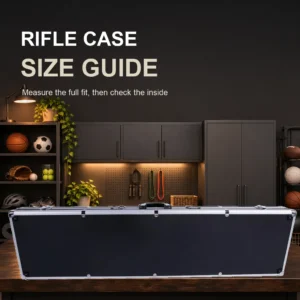
Custom Gun Case RFQ: 6 Checks Before You Approve a Sample
クイックアンサー:
A reliable custom gun case RFQ starts with the payload, not a catalog model. List item dimensions, required internal space, locks, handles, insert layers, branding, packaging and order quantity. Ask for a marked drawing, a defined sample approval record and a quote that states MOQ, timing and inclusions. SUNCASE’s OEM/ODM process includes design review and sample feedback. This guide covers specification control, not legal compliance.
Use this checklist for distributors, wholesalers, brand owners and procurement managers. Transport, storage and airline rules vary by market and carrier; confirm them with the relevant authority.
Start With the Payload, Not the Case Model
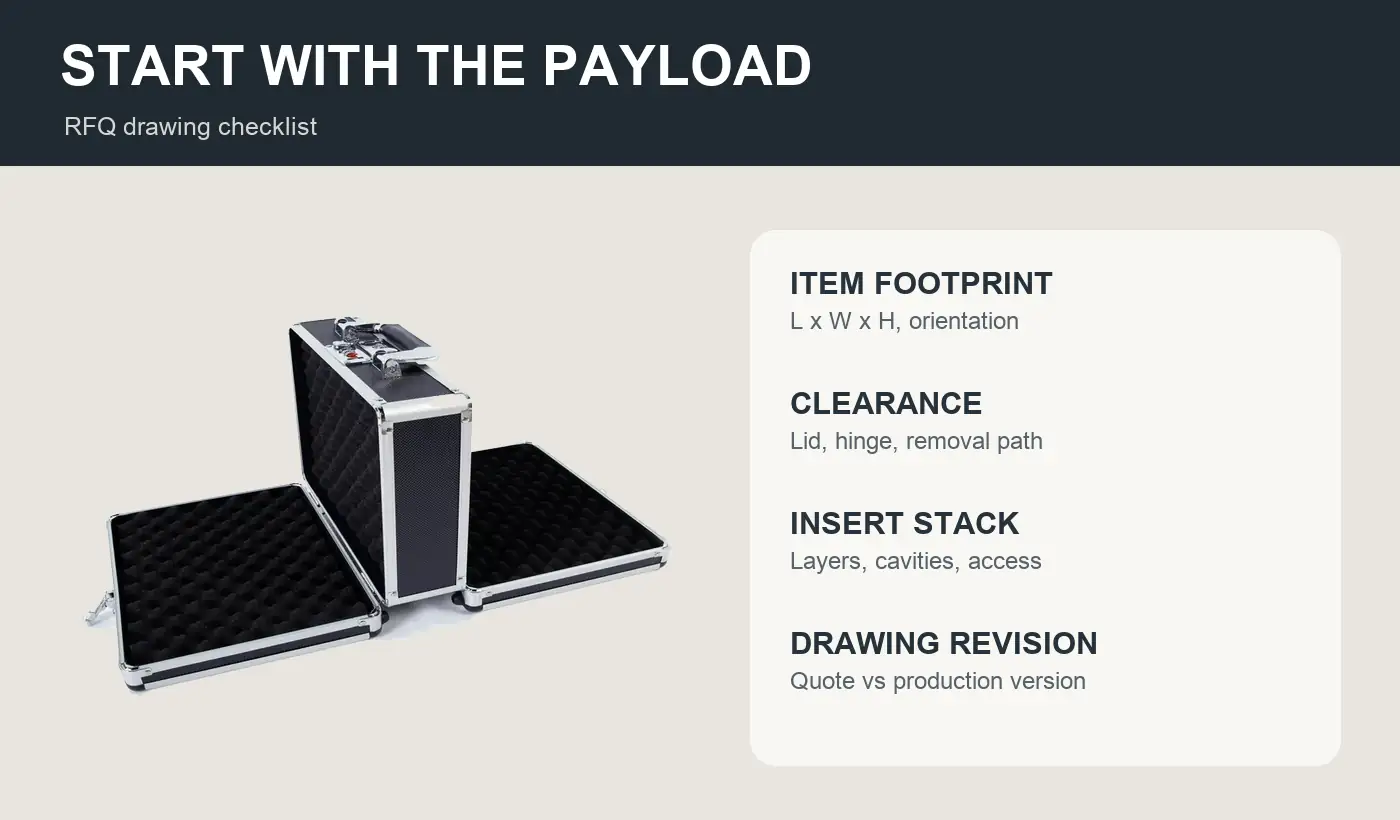
Buyers often choose a case first and force the contents to fit, which causes sample revisions. Start with what the case must hold, how many complete sets it carries and who will use it.
What Dimensions Should You Send?
Measure each item at its widest point in its stored orientation: firearm, magazines, optic, light, grip and adapters. If the items cannot be shipped, use a dimensioned drawing or approved replica and label it as a proxy.
| RFQ input | Record |
|---|---|
| Item dimensions | L × W × H at the widest point |
| Quantity | Items and spare magazines per case |
| Orientation | Muzzle direction and access side |
| Protrusions | Optics, lights, grips, sights, straps, connectors |
| Access clearance | Lid swing, hinge side and removal path |
| Units | Millimeters or inches, used consistently |
State the dimension order and whether each figure is external or internal. A drawing marked only “30 × 15 × 23” is ambiguous.
SUNCASE’s Z20 double-sided pistol case lists 30 × 15 × 23 cm or customize, but does not label the order or say whether the figures are external or internal. It also lists 100 pcs MOQ, 7-day sample time and 15–25 day delivery. These figures apply to the listed configuration; confirm them for the selected SKU.
What Should the Layout Drawing Show?
Use a dimensioned top view and side section. Show the outline, hinge side, handle and lock positions, every item footprint, clearance and any no-load area. Mark which items the user removes first. State whether the drawing is for quotation or production. If the buyer supplies CAD, a 3D model or a physical sample, review it through SUNCASE’s OEM/ODM process. Record the version reviewed and turn later email changes into numbered revisions.
Specify Lock and Handle Hardware on the Drawing

Lock and handle positions affect wall clearance, insert space and balance. Use exact hardware details, not “secure lock” or “strong handle.”
Which Lock Details Belong in the RFQ?
Specify type, count, position, operation and finish. For combination locks, ask whether each operates independently, how the code is set or reset, and what instructions come with the case. For keyed locks, state key quantity and whether keyed-alike options exist. Request a close-up and hardware specification.
The Z20 product name lists two combination locks, but the product description does not show their positions or whether they work independently. Put both on the drawing and check them on the sample.
How Do Handles Affect the Specification?
State fixed, folding or retractable, plus material, attachment and grip size. Test hand clearance and tilt with the loaded sample. For larger aluminum gun cases, ask separately about wheels or a pull handle. Do not infer features from a pistol case listing.
Define Insert Layers Before Comparing Foam
The insert turns case dimensions into usable space. “Foam included” is not a specification; define the layer stack, cavity dimensions, retention and material.
What Should the Insert Drawing Show?
Show each layer from floor to lid with thickness. Mark cavity L × W × D, corner radii, finger access, magazine wells, optic relief, straps and no-pressure areas. For double-sided cases, show both sides and which layer stays with each. State whether the insert is fixed or removable and show any spare cavity. Check lid foam compression against optic or sight height.
The Z20 page describes one thick grid-cut foam layer, two thin flat layers and a corrugated lid layer. It does not list the foam grade, density or thickness. Since the material row lists EVA, foam, fabric and PU lining, assign a material to each layer. SUNCASE’s guide to custom foam inserts for aluminum cases explains how construction, clearance and cutting affect fit.
How Do You Compare Insert Materials Without Guessing?
Ask for material, cell structure, density or firmness, thickness and finish for each layer. Confirm cut, die-cut, molded or pick-and-pluck; repeatability differs. Ask why the material suits the payload and check it on the sample. SUNCASE’s guide to foam for aluminum gun cases is a starting point, not a specification.
Pick-and-pluck suits a changing kit; repeat orders may need a cut layout. Compare tooling, MOQ, cost and revision time.

Tie Tests and Documents to the Claim
Request only the tests and documents needed for the claim the buyer intends to make.
What Testing Should You Request?
For impact, drop, water, dust, load or lock claims, define the property, method, sample configuration and acceptance criterion before quoting. Request the report date, laboratory, tested model, insert configuration and result. A component or similar-model report does not cover a new case. Keep the tested configuration tied to the production bill of materials. If no test is required, record that approval is based on dimensions, materials, workmanship and the sample only.
Which Documents Should Be Listed?
List the dimensioned drawing, bill of materials, insert drawing, hardware specification, artwork proof, packaging specification and inspection plan. If the destination requires declarations, name them and confirm who provides them. State document language and file format, and keep the approved revision with the purchase order.
Approve the Sample Against Measured Criteria
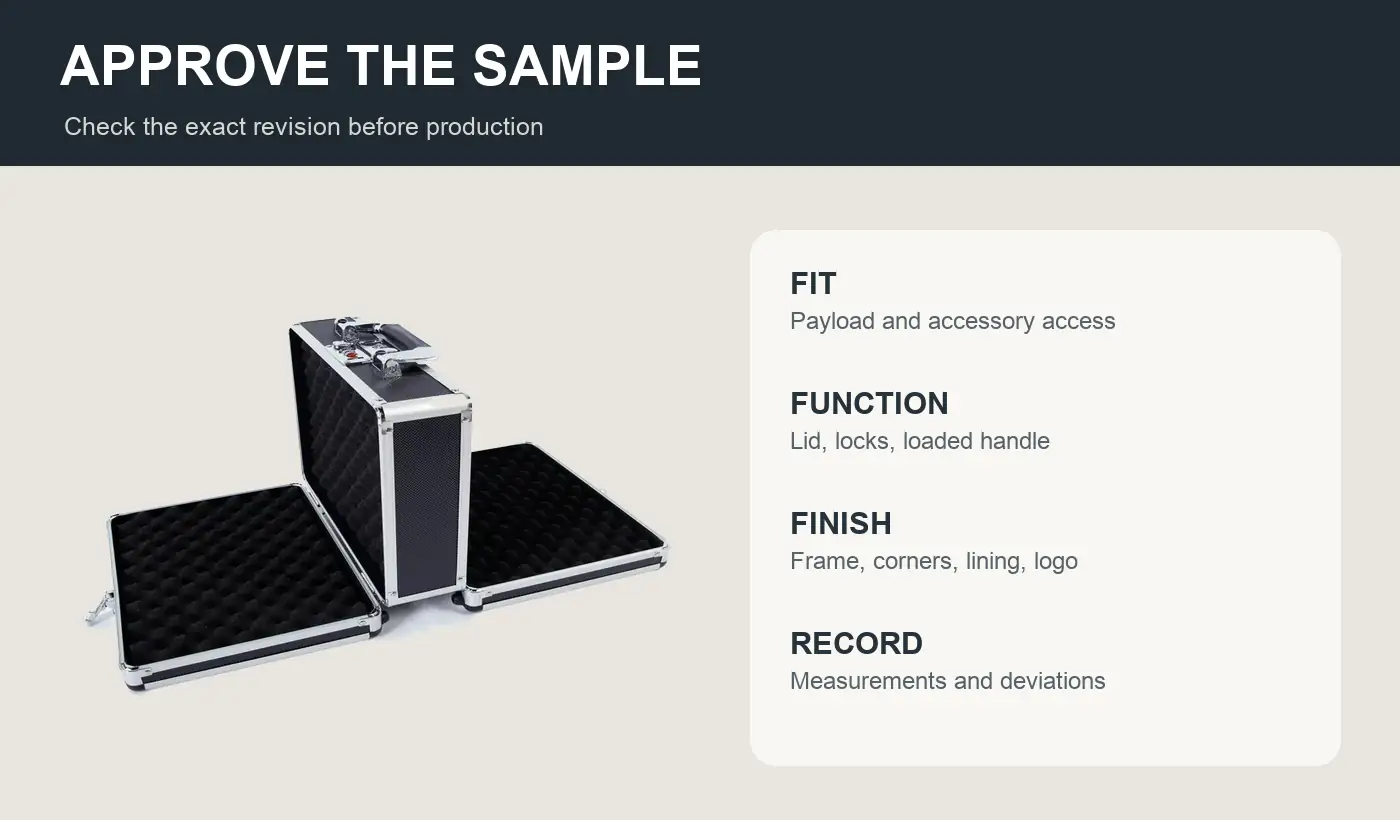
The sample shows whether the case, insert and hardware work together. Test with the real payload where lawful, or an approved replica, and compare it with the drawing.
How Should You Test the Sample?
Open and close it repeatedly. The lid should close without force; the insert should retain each item; accessories should clear neighboring cavities; locks and latches should align. Carry it loaded by the intended handle and check attachment movement. Inspect corners, frame, panels, lining, stitching, finish, logo and packaging. Photograph measurements and deviations using the drawing’s reference points.
What Should the Approval Record Include?
Record sample ID, SKU, revision, date, dimensions, insert layers, hardware, locks, color, logo, packaging and approved deviations. Attach photos, the marked drawing and approver name. State production tolerances and keep a sealed golden sample. Sample approval is not a certificate or legal review.
Put MOQ, Timing and Inclusions in the Quote
Two suppliers can quote the same custom gun case differently because one includes tooling, revisions, packaging or testing. Compare inclusions, not unit price.
How Should MOQ, Sample and Timing Be Quoted?
State MOQ by SKU, color, logo method and insert configuration. Confirm sample fee, credit against bulk, included revisions and what triggers a new charge. Define when timing starts, such as after drawing or artwork approval.
The sample and bulk timing figures for the Z20 do not define every start condition; custom inserts, branding or packaging can change the schedule.
What Commercial Details Prevent Rework?
Quote price validity, payment terms, Incoterm, named port or delivery point, carton size, gross weight, packaging and documents. State what happens if the sample changes, who owns drawings or tooling and how spare parts are identified. Add inspection criteria.
The Z20 page lists EXW, FOB, CIF, DDU and DDP terms and several payment methods; the quote should still name the exact term, destination and charges. For other formats, use the custom aluminum case range, then confirm the selected model.
Next Step: Send One Controlled RFQ Package
Include the payload list, dimension drawing, layout sketch, insert layers, lock and handle details, artwork, packaging, destination and quantity. Ask for a marked drawing and a quote that states assumptions. Approve the sample against that revision.
SUNCASE’s aluminum gun case range includes pistol, rifle and storage formats. If the Z20’s 30 × 15 × 23 cm size fits the payload, confirm its dimension order, internal space, lock layout and insert specification in writing.
Send the package through the SUNCASE contact page with drawings and quantities attached.
よくある質問
What Should Be in a Custom Gun Case RFQ?
Include item dimensions, quantity, orientation, internal space, case type, locks, handles, insert drawing, branding, packaging, destination and target quantity. Add test or document requests and sample approval criteria. The supplier should return a dimensioned drawing and a quote tied to that revision.
Should I Ask for Internal or External Case Dimensions?
Ask for both, clearly labeled. External dimensions describe the closed case’s footprint. Internal dimensions and usable cavity depth determine whether the payload fits after insert, lid foam and hardware. Never assume the catalog size is internal.
How Do I Specify a Lock for a Custom Gun Case?
Specify lock type, count, position, operating method and finish. Ask whether combination locks operate independently and how the code is reset. Request a close-up and hardware specification. Check the lock on the loaded sample; a product title is not a complete specification.
Is Pick-and-Pluck Foam Enough for a Production Order?
It can suit a variable kit or first sample, but may not give the same cavity shape in every unit. For repeat production, ask whether a cut insert is available and compare tooling, MOQ, cost and revision time. Confirm material and thickness either way.
What Should I Check Before Approving a Gun Case Sample?
Check loaded fit, lid clearance, insert retention, accessory access, lock and latch alignment, handle attachment, finish, logo and packaging. Measure against the drawing, record every approved deviation, and keep the sample and revision on file.
Can a Supplier Confirm That a Case Meets Transport Rules?
The supplier can provide specifications, drawings and any test reports it holds for the exact configuration. It cannot decide whether those satisfy every jurisdiction, carrier or use. Confirm transport, storage and airline rules with the relevant authority.
What MOQ and Lead Time Does the Z20 List?
The Z20 product page lists an MOQ of 100 pcs, a 7-day sample time and a 15–25 day delivery time. These figures apply to that model and configuration, not to every product or order. Confirm the sample fee, revisions and timing start in the quote.