Private-Label-Kosmetiktaschen: Vom Design bis zur Massenproduktion
Kurzantwort
Die Markteinführung einer Kosmetiktasche unter Eigenmarke erfolgt in sieben Phasen: Designbriefing, Herstellerauswahl, Mustererstellung, Individualisierung, Produktion, Preisgestaltung und Logistik. Die Mindestbestellmenge beginnt üblicherweise bei 500 Stück pro Design. Die Mustererstellung dauert ein bis drei Wochen. AQL 2.5 ist der Standard für die Textilinspektion. Zu den wichtigsten Zertifizierungen gehören GRS, BSCI, ISO 9001 und OEKO-TEX. Die Logooptionen reichen von Stickerei bis Prägung. Sun Case, ein Hersteller mit über 15 Jahren Erfahrung, bietet OEM- und ODM-Services, Muster innerhalb von fünf bis sieben Tagen und eine dreifache Qualitätskontrolle.
Hier ist ein Aspekt, den die meisten Markenleitfäden auslassen: Für eine Kosmetiktasche braucht man kein Labor, keinen Chemiker und keine jahrelangen Tests. Sie designen, branden und verkaufen sie. Sun Case Supply ist seit über 15 Jahren Direktvertriebspartner von Kosmetiktaschen und fertigt individuelle Taschen für Marken wie Estée Lauder, Mary Kay und L'Oréal Paris. Mindestbestellmenge ab 500 Stück. Muster innerhalb von fünf bis sieben Tagen. OEM und ODM möglich.
Die Private-Label-Chance bei weichen Kosmetiktaschen
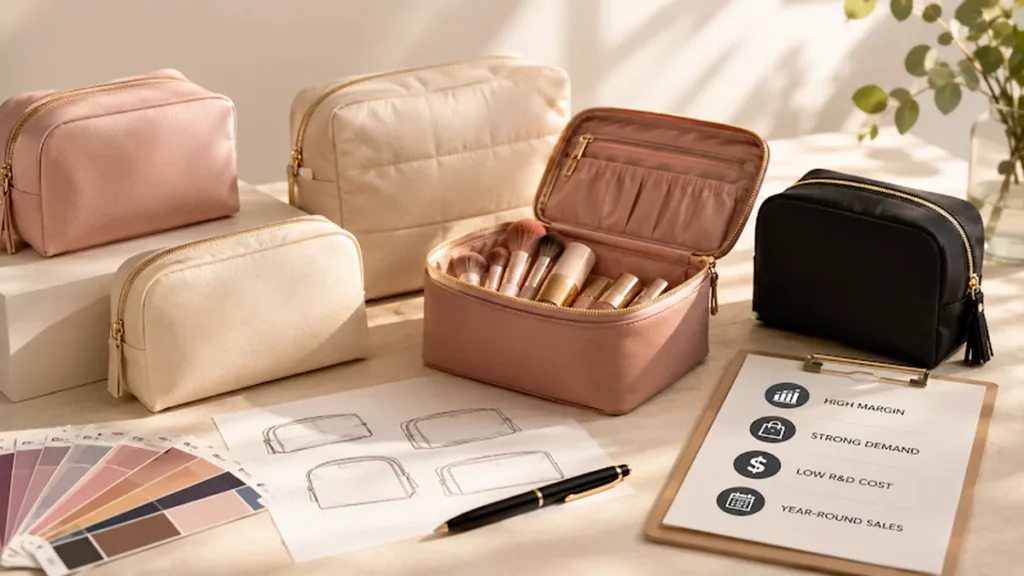
Keine Rezepturprüfung. Keine Probleme mit dem Verfallsdatum. Eine Marge, die sich im Direktvertrieb, Großhandel und Einzelhandel tatsächlich hält. Diese Kombination macht den Großhandel mit Kosmetiktaschen für Markenentwickler attraktiv, die ein echtes Produkt ohne den Aufwand für Forschung und Entwicklung suchen. Der Haken liegt in der Entscheidung des Herstellers. Liegt diese falsch, ist die Marge dahin, bevor überhaupt etwas ausgeliefert wird.
Phase 1: Konzept- und Designvorgaben
Markenidentität ist der Schlüssel zum Erfolg. Nicht umgekehrt. Luxusmarken setzen auf PU-Leder, geprägte Beschläge und Samtfutter. Funktionale Marken bevorzugen Nylon, strukturierte Fächer und robuste Reißverschlüsse. Öko-Marken greifen zu Bio-Canvas oder recyceltem Polyester. Budgetmarken halten es schlicht.
Wählen Sie nach dem Material die Form. Kompakter Beutel. Rolling Train CaseBürstenrolle. HängeorganizerEs handelt sich hierbei um grundverschiedene Produkte für grundverschiedene Käufergruppen. Technische Daten, Farbpalette und Spezifikationen müssen vor jedem Gespräch mit dem Hersteller vorliegen. Ein unklares Briefing führt zu einem nutzlosen Angebot und einem langwierigen Musterprozess.
Phase 2: Den richtigen Fertigungspartner finden
OEM, ODM oder White Label. Drei verschiedene Ansätze. Bei OEM liefern Sie eine fertige Spezifikation, die die Fabrik exakt umsetzt. ODM bedeutet, Sie wählen ein bestehendes Design und passen es an. White Label steht für Schnelligkeit bei minimaler Differenzierung. Sun Case Supply ist ein Direktvertriebspartner für Kosmetiktaschen unter Eigenmarken und deckt alle drei Optionen mit eigener Produktion ab. OEM- und ODM-Fähigkeiten.
Was einen guten Fertigungspartner von einem schlechten unterscheidet, hat nichts mit der Website zu tun. Es zeigt sich im Umgang mit der ersten Musteranfrage. Ob die Mindestbestellmenge (MOQ) dem tatsächlichen Produktionsvolumen entspricht. Ob die Individualisierung über einen einfachen Farbwechsel hinausgeht. Ob die Qualitätskontrolle dokumentiert oder nur behauptet wird. Ob E-Mails professionell beantwortet werden. Zertifizierungen, die vor einer Vertragsunterzeichnung angefordert werden sollten: GRS, BSCI, ISO 9001, OEKO-TEX.
Phase 3: Mustererstellung und Prototyping
Zuerst wird ein Prototyp erstellt. Dieser bestätigt die Designrichtung und die Materialwahl. Anschließend folgt ein Vorserienmuster, das alle Details vor Produktionsbeginn festlegt. Das Versandmuster am Ende bestätigt, dass das Endprodukt der Freigabe entspricht. Drei Muster sind erforderlich.
Kosten und Lieferzeiten variieren je nach Hersteller, Material und Designkomplexität. Viele Fabriken verrechnen die Kosten für Muster später mit der Großbestellung. Die Anfertigung erster Muster dauert in der Regel ein bis drei Wochen, abhängig von der Designkomplexität und der Produktionsauslastung. Prüfen Sie bei jedem eintreffenden Muster die Nähte, die Funktion des Reißverschlusses, die Haftung des Futters und die Farbgenauigkeit anhand der Farbpalette.
Phase 4: Anpassungs- und Branding-Optionen
Die Art der Logoapplikation hängt von den Materialeigenschaften ab. Stickerei eignet sich für Stoffe. Siebdruck ermöglicht kräftige, flächige Farben. Komplexe, mehrfarbige Grafiken lassen sich mit Thermotransferdruck realisieren. Prägung und Tiefprägung verleihen... PU-Leder Eine haptische Qualität, die mit billigeren Methoden einfach nicht erreicht werden kann.
Eine individuell gestaltete Kosmetiktasche ist mehr als nur der Platz für das Logo. Markeneigene Reißverschlüsse. Inneneinteilung, die auf die tatsächliche Nutzung durch den Endkunden abgestimmt ist. Verpackung: Staubbeutel, Geschenkbox, Anhänger, Einlagen. Unboxing-Fotos werden in Rezensionen gezeigt. Rezensionen beeinflussen Kaufentscheidungen. Marken, die der Verpackung keine Bedeutung beimessen, spüren dies in den Kundenbindungsraten.
Phase 5: Produktion und Qualitätskontrolle
Die Mindestbestellmenge für Kosmetiktaschen unter Eigenmarken beginnt in der Regel bei ca. 500 Stück pro Design. Sie variiert je nach Hersteller und Umfang der Individualisierung. Kleinere Mengen sind mitunter möglich, erhöhen aber die Stückkosten. Die Produktionszeiten hängen von der Bestellmenge, der Materialbeschaffung und der aktuellen Produktionskapazität ab. Vereinbaren Sie einen realistischen Liefertermin, bevor Sie einen Markteinführungsplan erstellen.
AQL 2.5 ist der von den meisten Herstellern als Maßstab für die Textilinspektion verwendete Standard. Zu den häufigsten Fehlern in dieser Kategorie zählen: Kräuselung der Nähte durch falsche Nahtspannung, Farbabweichungen zwischen Chargen und fehlerhafte Reißverschlüsse. Die Durchführung von Prüfungen durch SGS oder Intertek vor dem Versand bietet eine zusätzliche Kontrollinstanz, die bei der internen Qualitätskontrolle allein mitunter fehlt.
Phase 6: Kostenaufschlüsselung und Preisstrategie
Die Stückkosten variieren je nach Material, Konstruktionskomplexität, Bestellmenge und Individualisierungsgrad. Einfache Polyesterbeutel sind günstiger. Hochwertige Modelle aus PU-Leder oder Canvas sind teurer. Fordern Sie aktuelle Angebote an, anstatt sich auf Vergleichswerte zu verlassen. Marktbedingungen beeinflussen die Preise so stark, dass feste Referenzpunkte unzuverlässig werden.
Werkzeugkosten. Musterkosten über mehrere Korrekturrunden hinweg. Luftfrachtzuschläge bei längeren Produktionsläufen. Qualitätskontrolle. Eigenmarkenverpackungen für Kosmetikprodukte erhöhen die Stückkosten, können aber einen deutlich höheren Verkaufspreis ermöglichen. Rechnen Sie vom angestrebten Verkaufspreis aus, um sicherzustellen, dass die Gesamtkosten tragfähig sind, bevor Sie die Produktion festlegen.
Phase 7: Verpackung, Logistik und Markteinführung
Einzelverpackung im Polybeutel, Einzelkarton, Umkarton – das ist die Standard-Exportverpackung. Individuelle Einzelhandelsverpackungen eignen sich für den Direktvertrieb und den Geschenkartikelhandel und ermöglichen einen höheren Preis. Die Lieferzeiten aus China variieren je nach Spediteur, Route und Saison. Seefracht ist pro Kilogramm günstiger. Luftfracht ist teurer, aber schneller. Erfragen Sie die aktuelle Lieferzeit bei Ihrem Spediteur, bevor Sie einen Starttermin festlegen. Jeder ausgehende Karton benötigt den korrekten HS-Code und die Kennzeichnung des Ursprungslandes für die Zollabfertigung.
Fallstudie: Einführung einer Eigenmarke mit Sun Case Supply
Beispielhafter Ablauf eines Private-Label-Kosmetiktaschenprojekts mit Sun Case Supply: Eine Marke präsentiert ein dreiteiliges DTC-Konzept. Hochwertige Optik zu wettbewerbsfähigen Kosten – das ist die Vorgabe. Nylonkorpus, Besatz aus PU-Leder, individuell geprägtes Logo, Samtfutter, Markengeschenkbox. Der Prototyp wurde in der ersten Woche geliefert. Eine Korrekturrunde. Die Vorproduktion wurde kurz darauf freigegeben. Die Serienproduktion wurde innerhalb des vereinbarten Zeitrahmens abgeschlossen. Das Set wurde zu einem Premiumpreis eingeführt und verkaufte sich im ersten Verkaufsfenster sehr gut.
Abschluss
Jede Entscheidung in diesen sieben Phasen wirkt sich auf die Endproduktqualität, die Kosten und die Marktposition aus. Eine frühzeitige Fehlentscheidung bei der Herstellerwahl verursacht in jeder nachfolgenden Phase höhere Korrekturkosten. Sun Case Supply bietet Direktvertrieb ab Werk. OEM und ODM Herstellung von Kosmetiktaschen für Eigenmarken. Dreifache Qualitätskontrolle. Kosmetiktaschen im Großhandel ab 500 Stück. Musterlieferung innerhalb von fünf bis sieben Tagen. Kontaktieren Sie Sun Case Supply für eine Beratung zu Eigenmarken und ein Angebot direkt ab Werk.
Häufig gestellte Fragen
Wie hoch ist die Mindestbestellmenge für Kosmetiktaschen aus weichem Material unter Eigenmarken?
Die Mindestbestellmenge beträgt üblicherweise etwa 500 Stück pro Design, kann aber je nach Hersteller und Umfang der Individualisierung variieren. Sun Case Supply nimmt Bestellungen ab 500 Stück mit vollständiger OEM-Individualisierung hinsichtlich Logo, Material, Farbe und Innenausstattung entgegen.
Wie lange dauert die Produktion von Kosmetiktaschen aus weichem Material unter Eigenmarken?
Die Bearbeitungszeit variiert je nach Komplexität des Designs und der Produktionskapazität zum Zeitpunkt der Bestellung. Die Mustererstellung dauert in der Regel ein bis drei Wochen. Bitte bestätigen Sie die genauen Produktionszeiten direkt mit dem Hersteller, bevor Sie sich auf einen Markteinführungstermin festlegen.
Welche Individualisierungsoptionen gibt es für Kosmetiktaschen unter Eigenmarken?
Stickerei, Siebdruck, Thermotransferdruck, Prägung, Tiefprägung für Logos. Individuelle Reißverschlussanhänger, Beschläge, Inneneinteilung, Trennwände, Bürstenfächer. Verpackungsoptionen umfassen Geschenkboxen, Staubbeutel, Anhänger und Markeneinlagen.
Welche Zertifizierungen sollte ein Hersteller von Kosmetiktaschen unter Eigenmarken besitzen?
GRS für Recyclingmaterialien. BSCI für soziale Verantwortung. ISO 9001 für Qualitätsmanagement. OEKO-TEX für Textilsicherheit. Fordern Sie Zertifikate für die in Ihrem Produkt verwendeten Materialien an, bevor Sie eine Großbestellung aufgeben.