دليل توريد معدات الصالون: الفئات والمواد وفحوصات البيع بالجملة
إجابة سريعة
Salon equipment covers furniture, tools, storage and mobile workstations used in beauty and barber services. For wholesale buyers, the main sourcing task is to match each product to its use, market requirements, available specification and landed cost. SUNCASE lists portable makeup and barber cases, lighted workstations and salon chairs, alongside an OEM/ODM inquiry process that includes sample feedback. Confirm materials, options, MOQ, documents, lead time and inspection terms for every model before ordering.
What Is Salon Equipment? Categories and Product Types Explained
The term salon equipment is broad. It can include fixed salon furniture, portable cases for tools or cosmetics, rolling trolleys, lighting and workstations. Buyers who treat these categories as interchangeable risk comparing different products, underestimating freight or stocking equipment that does not fit their customers’ work routines.
Start by separating products according to how they are used. Chairs and stations support a fixed service area. A makeup case or barber case stores and carries tools. A trolley adds mobility and may combine storage with a temporary work surface. Beauty cases may be aimed at consumers, makeup artists or professional distributors, so product names alone do not define the intended configuration.
For a distributor’s range, this distinction helps organize purchasing and sales information. It also makes supplier quotations easier to compare: request like-for-like dimensions, materials, accessories and packaging instead of asking for a broad “salon equipment” price.
Which Products Belong on an Essential Salon Equipment List?
An essential list depends on the services and sales channel. A salon owner outfitting a location may need chairs and fixed stations, while a beauty supply distributor may carry cases and portable storage that professionals can replenish or take to appointments. A barber supplier may need tool cases for clippers, trimmers and scissors alongside seating products.
Useful product groups include:
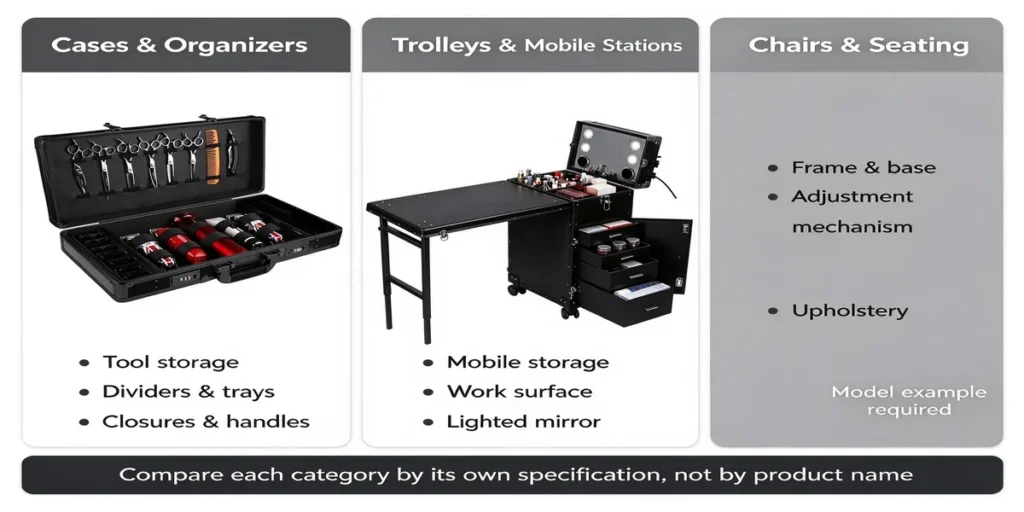
- Chairs and seating: barber chairs, styling chairs and makeup chairs; compare dimensions, adjustment mechanism, upholstery and documentation.
- Cases and organizers: makeup cases, beauty cases and barber cases; compare usable interior space, dividers, trays, locks, straps and handles.
- Trolleys and mobile stations: rolling storage or portable workstations; check wheels, access, setup needs and packed dimensions.
- Tools and accessories: confirm compatibility and whether these are included or sold separately.
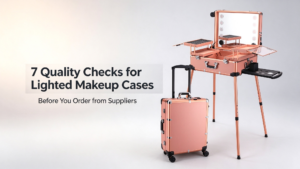
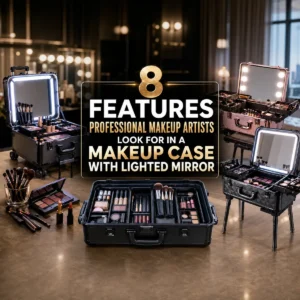
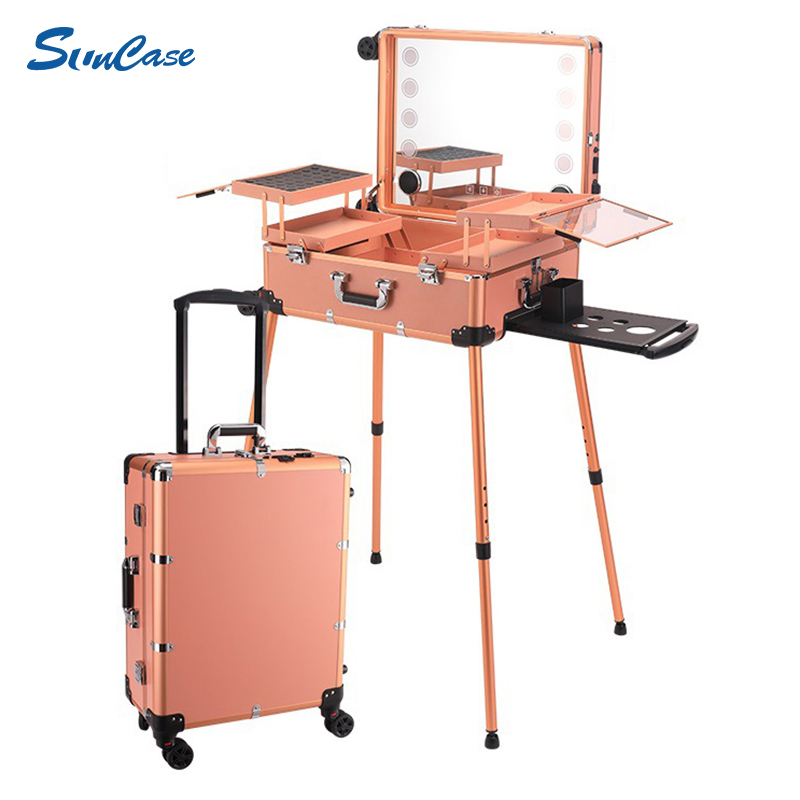
SUNCASE lists a lighted makeup artist trolley with mirror, adjustable legs and rolling wheels and a trolley nail makeup station with a lighted mirror and adjustable table. These listings show portable workstation formats. Check each page for the model-specific size, materials and included features before deciding which belongs in your salon equipment wholesale assortment.
How Should Buyers Compare Aluminum, Stainless Steel and Plastic?
Material comparisons need to be tied to the component and use. “Aluminum” may refer to a frame or exterior trim while panels use MDF, ABS or another material. Stainless steel may be used in particular furniture components, while plastic can reduce weight or support specific shapes. A single material label does not describe a complete product’s performance.
For a chair, ask about the frame, base, adjustment mechanism and upholstery. For a case, ask separately about frame, panels, lining, hardware and interior. For plastic parts, identify the exact polymer where it matters to use or compliance. Compare construction, care needs, weight, repairability and price against your sales channel rather than assuming one material is always superior.
The website lists a barber stylist suitcase with an aluminum frame, melamine panel, MDF board and hardware. It separately lists a barber styling chair with metal, PU leather and hardware. This contrast shows why buyers should compare the bill of materials by product type and confirm the selected SKU rather than generalizing across a supplier’s catalog.
What Should Buyers Expect When Sourcing Salon Equipment from China?
Wholesale sourcing involves more than unit price. Buyers need to compare MOQ, sample cost, customization, packing, freight, duties and the time required for approval and production. Lead times are order- and model-specific, so ask for the current schedule and the conditions that start the clock, such as artwork approval, deposit or sample sign-off.
Send suppliers a clear brief: product or reference model, quantity, destination, dimensions, intended use, preferred materials, color and branding. Request an itemized quotation with currency, Incoterm, packing assumptions, payment terms, sample terms, production timing and any documents available for the exact item. This creates a fairer comparison between salon equipment suppliers and reduces the risk of hidden configuration differences.
SUNCASE describes OEM and ODM inquiry paths. Its published process begins with drawings, a 3D file, a sample or functional requirements, followed by feasibility discussion and sample feedback before production. Treat this as the website-described process; confirm current MOQ, sample schedule, production time, shipping terms and responsibilities in writing for each order.
How Can OEM Customization Build a Salon Equipment Line?
OEM customization can help a brand create a consistent assortment, but not every requested change is practical on every model. A logo may be straightforward on one surface and unsuitable on another. A new size or compartment layout may affect tooling, packaging, MOQ and production timing.
Define which details need to be consistent across the range: logo method and placement, colors, material finish, interior layout, labels, instructions and packaging. Identify what may vary by model. Then ask salon equipment manufacturers to confirm feasibility, added costs, sample requirements and any artwork or tooling charges before placing a bulk order.
For portable products, useful SUNCASE examples include the lighted trolley formats above and a barber case designed for clippers, trimmers and scissors. The listed barber case page notes logo customization. Buyers can share a reference image or drawing, target quantities and branding files, then approve a sample or proof that reflects the final configuration. This is especially helpful when a distributor needs repeatable product photos, packaging and sales descriptions across multiple SKUs.

What Quality Checks Should Be Completed Before Shipment?
Quality control should follow the written order specification. First confirm model, dimensions, materials and accessories. Then inspect the functions that matter: chair adjustments and stability, case closures and handles, trolley movement, mirror and light operation, tray access, finish and carton condition. Any required test or market document should be requested for the exact model and configuration.
Agree on the inspection method, sample size, defect categories, acceptance criteria and photo or record requirements before production. A sample review can catch fit or finish issues, but does not prove every unit will match or establish certification. If a claim such as load capacity, impact resistance or electrical compliance matters, request the supporting test basis and scope rather than relying on a title or image.
For multi-product orders, use a separate checklist for each category. A chair needs different checks from a makeup case; one generic checklist can miss functional issues. Confirm packaging dimensions and carton quantities as well, since freight cost and handling damage directly affect a distributor’s margin.
التعليمات
1. What is included in salon equipment?
The term can cover salon furniture, chairs, stations, trolleys, portable makeup and barber cases, and tools. Specify the product category and intended use when requesting a quote.
2. How do I compare salon equipment wholesale prices?
Compare the same model, materials, configuration, accessories, packaging, MOQ, Incoterm, destination charges and sample terms. A low unit price may exclude options or use different packing assumptions.
3. What should a beauty supply distributor check before ordering?
Confirm the target customer, SKU, usable dimensions, materials, color, accessories, labeling, carton details, MOQ, lead time and any required market documents. Approve the final sample or artwork before bulk production.
4. How can I evaluate salon equipment manufacturers?
Ask for model-specific specifications, a clear quotation, sample and approval steps, inspection scope, available documentation and written commercial terms. Do not rely on broad claims that are not supported for the product you plan to buy.
5. Can salon equipment suppliers customize products?
Some suppliers offer OEM or ODM options. Confirm which changes are feasible on the selected item and how they affect MOQ, price, samples, tooling, timing and intellectual-property terms.
Source Salon Equipment Against a Clear Brief
Successful sourcing starts with a defined assortment and comparable specifications. Separate fixed furniture from mobile stations and cases, confirm material details by component, and align samples, packaging and inspection with the actual order. SUNCASE’s catalog includes portable beauty and barber cases as well as salon chair listings, and its website describes OEM/ODM support. Share your target products, quantities, destination and branding needs to review suitable models and verify current terms.