
Barber Case Wholesale Buying Guide: Size, Compartments, Materials and Custom Branding
Quick Answer:
Wholesale buyers should select a barber case by matching its usable size and compartments to the clipper, trimmer, scissor and accessory sets customers carry. Compare shell and frame materials, hardware, cleaning needs and loaded weight, then confirm fit with a sample. For private-label orders, document logo and packaging requirements alongside MOQ, timing and inspection terms. Sun Case lists barber and aluminum case formats; verify the exact model’s configuration and commercial details before ordering.
The right barber case keeps a professional’s tools organized and helps distributors build a useful product range. But the name alone does not tell a buyer what fits, how it carries or what customization is included. This guide covers the format, layout, materials and sourcing checks to use when comparing a barber tool case for wholesale.
What Barber Case Formats Should Wholesale Buyers Compare?
Barber cases can range from compact carrying cases to rigid cases with multiple compartments or workstation-style layouts. A barber carrying case for a few clippers and scissors has a different job from a larger kit used by a mobile barber. Decide whether the customer needs transport, storage, organization at a workstation or a combination.
Consider the sales channel too. A beauty supply retailer may need several sizes at different price points; a professional distributor may want one case tailored to a common tool set. Review dimensions, access and portability for each format. Product photos help with initial comparison, but a sample or dimensioned drawing is needed to confirm actual fit.
Sun Case lists a barber case product category with custom aluminum case formats to review. Confirm that the selected model is intended for barber tools and ask for the current interior layout, dimensions and included accessories.
How Should Case Size and Layout Match Barber Tool Sets?
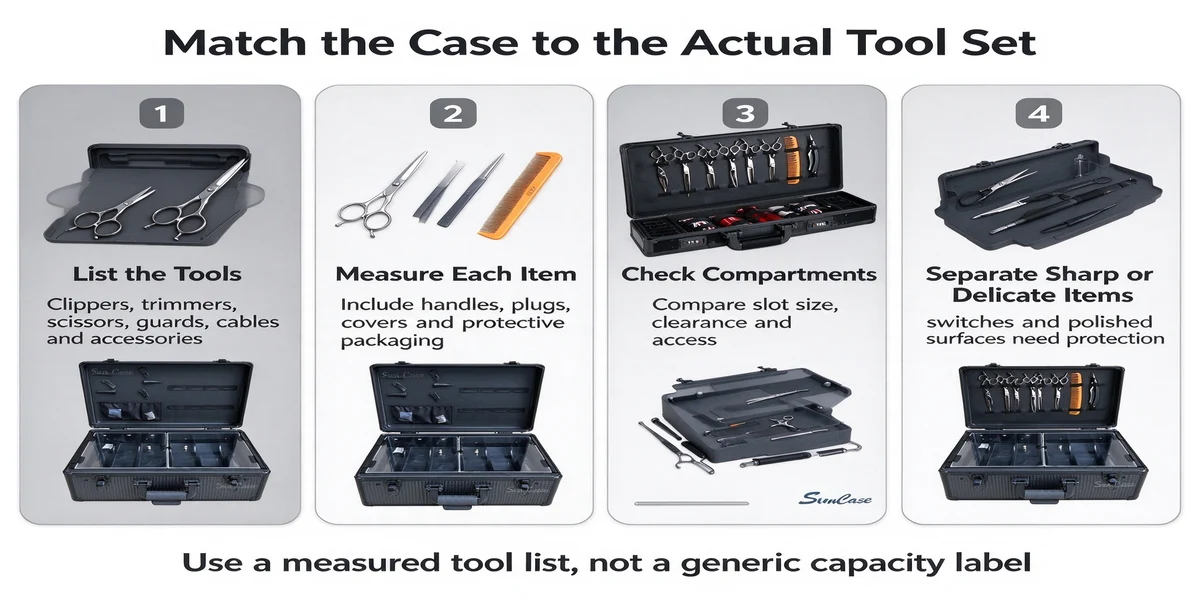
List the tools by type and quantity: clippers, trimmers, guards, scissors, combs, brushes, chargers, cables and cleaning accessories. Measure each item, including protective covers and plugs. Identify which tools must remain separated and which are used most often. This gives a supplier a clear basis for recommending a layout.
Internal dimensions matter more than external dimensions for fit. Measure compartments individually and check clearance around handles and cables. A barber case for clippers should allow tools to be removed without forcing them past dividers. If equipment is added or changed seasonally, consider adjustable storage rather than a fixed layout designed for one exact set.
Also think about access. A case may close easily yet make tools hard to reach once opened. Check whether trays obstruct one another and whether the user can identify items quickly. If a barber carries supplies to clients, verify the loaded weight and balance, not only the empty case weight.
How Should Buyers Compare Interior Protection and Organization?
The interior should prevent tools from shifting into one another while allowing quick retrieval. Options may include elastic straps, pockets, dividers, fitted foam or removable trays. Each has trade-offs: fixed compartments can be organized, while flexible layouts can accommodate a broader range of tools.
Identify sharp edges, blades, screens, switches or polished surfaces that need separation. Confirm whether the interior can be cleaned and whether pockets suit the actual accessories. Test the loaded case by carrying it as intended, then inspect whether tools move, collide or press on the lid. Do not assume a case is protective because it has a padded lining; specify the protection requirement and validate the selected construction.

What Shell, Frame and Hardware Construction Should Be Compared?
Ask suppliers to state materials by component. Some cases use an aluminum frame with composite panels, while others may use fabric or molded materials. The construction affects appearance, weight, care and cost. A material label does not describe the whole case, so request details about the frame, panels, lining, corners and hardware.
Check hinges, latches, locks, handles and fasteners on the sample. Open and close the case repeatedly, confirm the latch aligns and inspect the handle attachment. If the case will be carried daily, test the grip with a representative load. Ask what components are standard and what can be customized for the selected model.
How Do Portability and Cleaning Affect Daily Salon Use?
A case used in a salon may remain near a workstation, while a mobile barber needs manageable weight, secure closure and convenient carrying. Consider stairs, public transport, vehicle storage and the frequency of setup. If the case is large, decide whether a rolling option is more useful than a shoulder strap or hand carry.
Hair, product residue and dust can collect around dividers, seams and pockets. Ask how surfaces should be cleaned and whether removable sections can be wiped separately. Review the zipper or latch area for access and snag points. Practical cleaning details can influence the durability and customer experience even when the case is not exposed to harsh conditions.
Which OEM and Private-Label Options Matter for Barber Brands?
Branding may include a logo plate, print, color, labels or packaging. Specify artwork, placement, size and finish. Ask whether the surface and construction support the proposed method and whether it affects MOQ, tooling, cost or schedule. Approve a proof or sample before a bulk run.
Custom interiors can help differentiate a barber tool case, but changes should be tied to a measured tool list. Provide dimensions and photos, identify items that need separate slots and state whether the layout should be adjustable. Document the approved version so restocking uses the same arrangement.
Sun Case describes OEM/ODM work that can start with a drawing, sample or functional requirements. Share your branding files, target quantities, case reference and tool set to discuss feasibility. Confirm sample terms and production scope in the current quotation.
How Do MOQ, Sample Approval and Production Planning Work?
MOQ varies by case type and level of customization. Request current terms for the standard model and any branded version separately. Ask for sample charges, production timing, packaging details and what approvals must be completed before production begins. For a new layout, factor in time for sample feedback and revisions.
Plan quantities around the customers and channels you serve. A larger order may reduce unit price but increase inventory and freight exposure. Compare the total landed cost, including packaging, freight and destination charges. Record the exact model, materials, dimensions and branding in the purchase order so the supplier quote and approved sample refer to the same product.
What Barber Case QC Checklist Should Buyers Use?
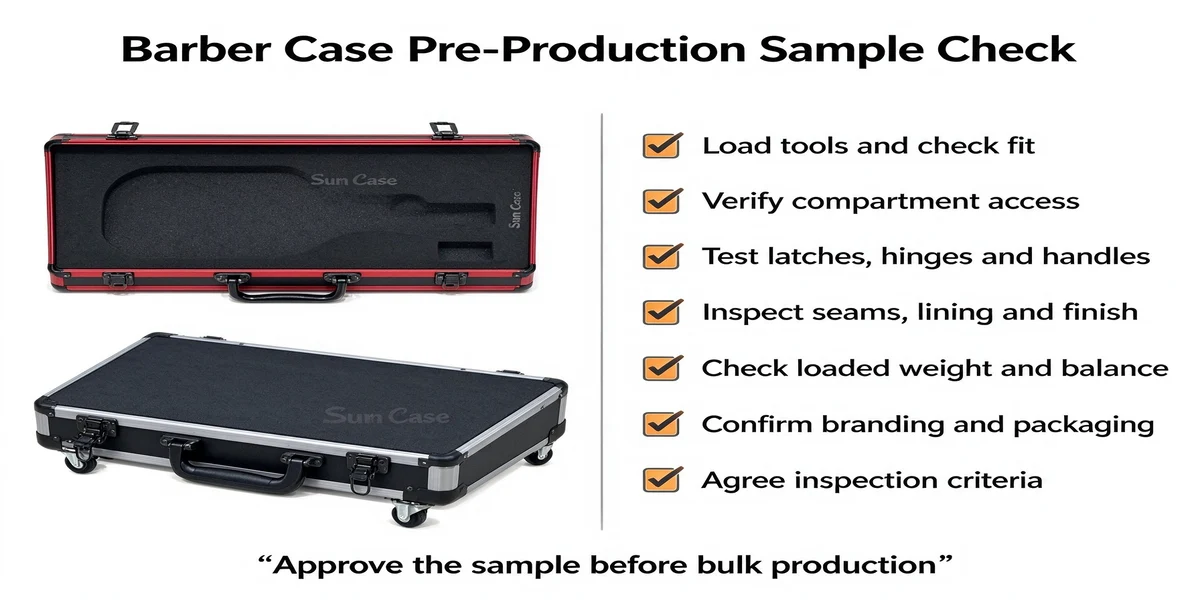
Before a bulk order, inspect a representative sample against the written requirements:
- Fit: Load the clipper, trimmer, scissors, guards, cables and accessories listed in the brief.
- Access: Open trays and remove tools without forcing them or disturbing neighboring items.
- Retention: Carry the loaded case and check that tools remain in their assigned places.
- Construction: Inspect seams, panels, corners, lining, dividers and finish.
- Hardware: Operate latches, locks, zippers, hinges and handles repeatedly.
- Weight and comfort: Assess the loaded case using the customer’s expected carrying method.
- Branding: Compare logo, labels, color and packaging with the approved proof.
- Order checks: Agree inspection scope, defect categories, sample size and acceptance criteria.
Record findings with photos and identify the sample version. If a protection or load claim matters, request its test basis for the exact model rather than using a general product description.
What Information Belongs in a Barber Case RFQ?
Include the target user, use scenario, tool list, dimensions, expected load, layout preferences, material expectations, branding, quantity, destination and schedule. Attach drawings or photos and identify any sharp or delicate items that need protection. Ask for internal measurements, materials by component, sample terms, MOQ, packaging, inspection options and current shipping terms.
This concise brief lets suppliers quote comparable cases and surfaces assumptions early. A clear request also helps prevent a product listing’s generic features from being mistaken for the final configuration.
FAQ: Buying Barber Cases Wholesale
1. What size barber case do most professionals need?
There is no single standard size. The required format depends on the tools, accessories, carrying method and whether the user needs storage only or an organized workstation. Measure the intended kit.
2. Will a barber case for clippers fit every clipper brand?
Not necessarily. Tool dimensions and accessories vary. Check the internal slots and compartment sizes with representative clippers and trimmers before making a compatibility claim.
3. What is the difference between a barber tool case and a barber carrying case?
The terms can overlap. Confirm the actual construction, layout, size and carrying features instead of relying on the product name.
What should distributors confirm before a private-label order?
Confirm logo artwork and placement, case configuration, materials, MOQ, sample approval, packaging, production timing and inspection criteria in writing.
Select the Case Around the Tools
A wholesale barber case should fit the tools customers actually use, stay practical to carry and hold up to repeated opening and closing. Compare the interior layout and construction on a sample, then confirm branding, MOQ and inspection terms before production. Sun Case’s listed aluminum case range offers a starting point for comparison; share your tool list, quantities and brand requirements to discuss a suitable configuration.

