Trolley Makeup Case Wheel and Handle Tests: A Wholesale Sample Checklist
Quick Answer
First define the loaded weight, center of gravity and route the sample must handle. Then check wheel attachment and movement, telescopic handle extension and wobble, stability under the declared load, and condition after repeated handling. Record pass and fail descriptions in the RFQ. SUNCASE’s SC-B9017 trolley makeup case lists four 360° swivel wheels, two of them lockable; confirm the exact SKU and quoted configuration in writing before sampling.
Define the Load and Route Before Testing
A wheel test is useful only when the load and route are stated.
What Load Should the Sample Represent?
Use the packed weight the end user will move, including products, nail-polish storage and accessories. If the assortment is not final, set a test load and maximum operating load. Ask the supplier to confirm ratings for the complete case and the wheel assembly; they may differ. Do not infer either from frame size or another rolling makeup case.
SUNCASE’s SC-B9017 page lists a 380 × 290 × 760 mm size, four 360° swivel wheels and two lockable wheels, but no wheel load rating, maximum case load or handle specification. Put those on the quotation.
Which Route and Obstacles Matter?
Record the surfaces the case will meet: smooth flooring, tile joints, low carpet, thresholds, ramps and curbs. Note car loading and room-to-room movement for mobile artists. Then write a repeatable route into the sample request, such as: roll the loaded case across smooth floor, over one raised threshold and around two right-angle turns; stop, lock and unlock the wheels, then continue. Use the same route for every sample and bulk comparison.
Why Does Center of Gravity Change the Test?
Drawers, a folding table, a lighted mirror lid and an adjustable work surface can shift the balance. Check both transport and working configurations. With the case loaded and upright, all wheels should share the load and the case should not feel ready to tip during a normal pull. With the side table extended, support should remain stable. Test open drawers only in a safe, controlled setup.
Check Wheel Attachment, Tracking and Locking
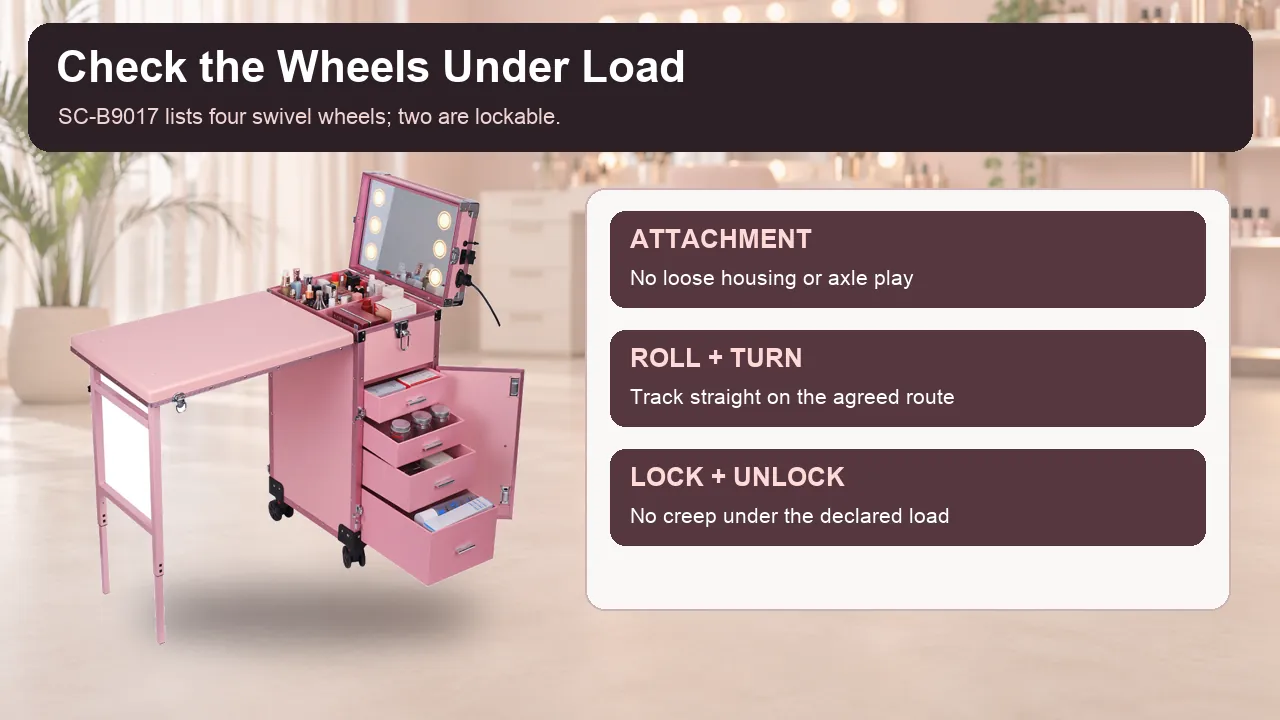
Inspect the makeup trolley wheels before rolling. A loose housing or damaged axle may only show under load.
What Should You Inspect Before Rolling?
Check that each wheel is present, seated and free of cracks, sharp edges or trapped packaging. Try to move it by hand to find play at the axle or housing. Confirm fasteners are present and look for rubbing marks. On a flat surface, check that all four wheels touch the floor. A gap may be acceptable if the frame has designed flex, but record it and compare it with the approved sample.
How Do You Run a Repeatable Rolling Check?
Use the declared load and marked route. Push and pull at a normal walking pace, turn both ways, and listen for scraping, clicking or repeated impact. Watch whether the case tracks straight. Inspect after each stage. Record what was done, observed and measured, plus the accept or reject decision. “Front-right wheel clicked on tile and moved at the housing” is more useful than “wheel felt rough.”
What Must a Lockable Wheel Prove?
Engage each lockable wheel and try to roll the loaded case. The locked wheel should not rotate or let the case creep. Confirm which wheels lock and how the mechanism operates. SC-B9017 lists two lockable wheels but does not describe the lock; request a photo or video. After unlocking, check that each wheel moves freely. A lock that slips under the packed load is not acceptable.
Test Telescopic Handle Extension and Wobble
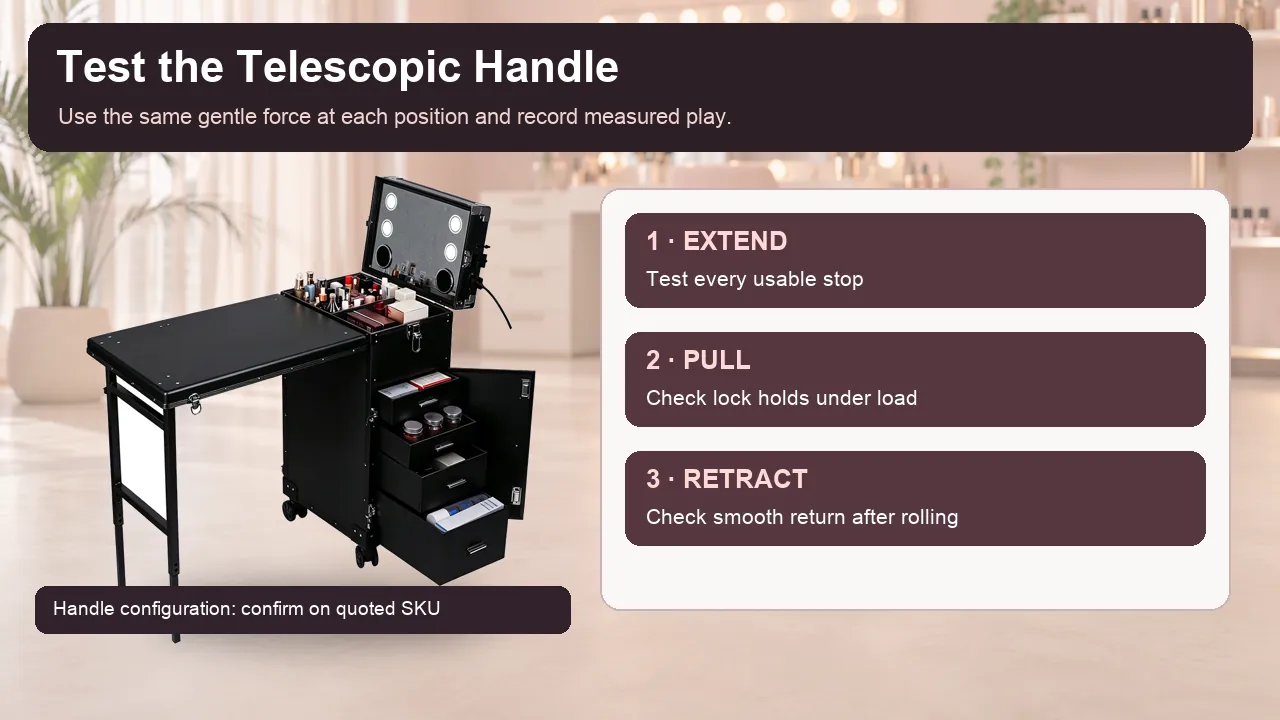
The handle includes tubes, guide sleeves, a release mechanism, a grip and the frame attachment, so test it as a system.
Which Handle Positions Need Testing?
Test fully retracted, normal pulling and fully extended positions. If there are intermediate stops, test each one. Extend and retract several times empty, then repeat with the declared load. Check for binding, tube misalignment, scratches, dents and a release that requires a hard jerk. A handle can work while still being tiring to use all day.
How Do You Measure Wobble?
Set the case on a flat surface and extend the handle to the position being evaluated. Apply the same gentle side-to-side and front-to-back force at the grip for each sample. Measure movement and record direction and amount. Do not rely on “it feels loose.” Set a maximum for the exact model, repeat loaded and after rolling, then inspect the guide sleeves, tube joints and frame attachment if play increases.
How Do You Check Locking and Retraction?
Pull the extended handle in the direction of travel with the load applied. It should hold the selected position without collapsing. Check that the release does not catch on the case, drawers or the user’s hand. Retract fully and confirm it stays closed for transport. SC-B9017 does not publish tube material, stages, extension range, wobble tolerance or handle load rating; request those details before bulk production.
Inspect the Case After Repeated Handling
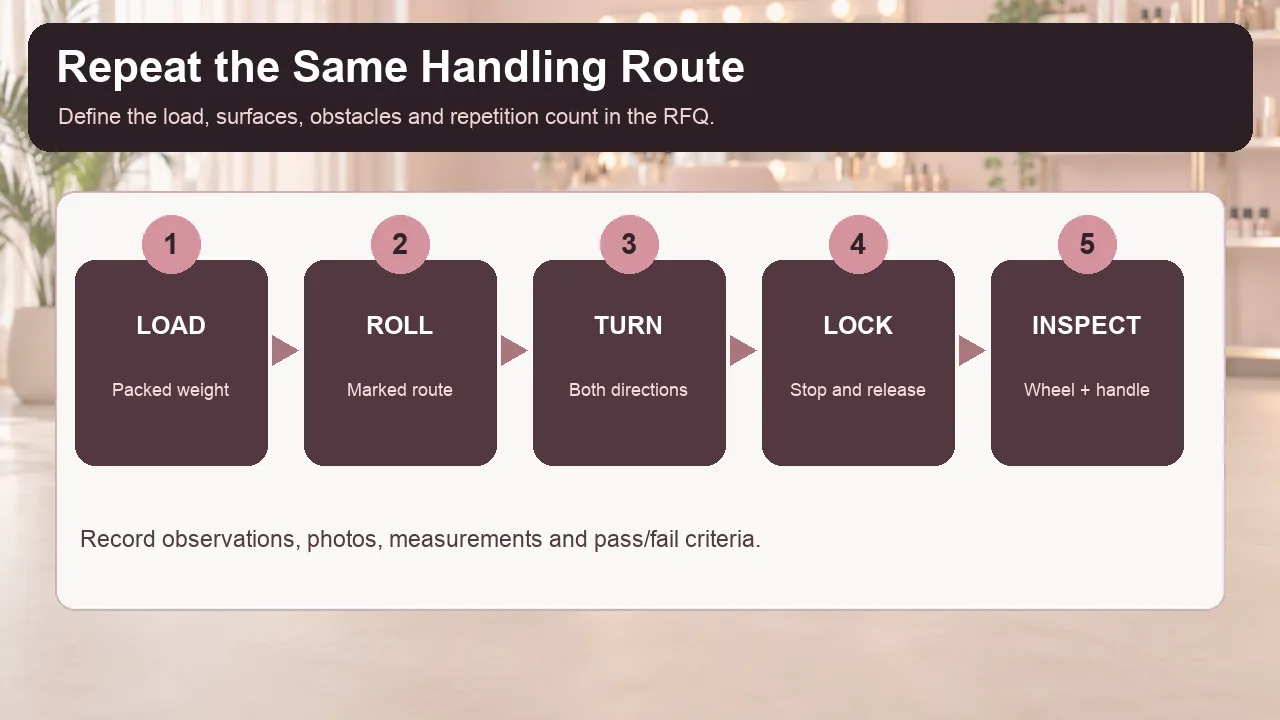
Repeated handling exposes movement a short demonstration can miss. Load the case, extend the handle, roll the agreed route, turn, stop, lock and unlock the wheels, retract and repeat. Record the repetition count.
After each block, inspect wheel housings, axle areas, frame joints, corner caps, latches, hinges, drawer runners, table supports and mirror fixings. Look for loose screws, cracked plastic, deformed metal, elongated holes, wheel flat spots, handle-tube scratches and changes in lock action. Photograph the same areas before and after.
Stop if the case becomes unstable, a wheel binds, a fastener backs out repeatedly or the handle fails to lock. Mark the sample and ask the supplier to explain the cause before repair.
Put Wheel and Handle Criteria in the RFQ
Replace “premium wheels” and “strong handle” with observable criteria. The RFQ should let two people repeat the same test and reach the same decision.
| RFQ field | What to write |
|---|---|
| Sample identity | model, color, logo method, mirror and table configuration |
| Test load | packed weight, distribution and maximum intended load |
| Route | surfaces, threshold, turns, ramp and repetition count |
| Wheels | attachment, rotation, tracking, locking and inspection points |
| Handle | positions, lock engagement, measured wobble and retraction |
| Acceptance | pass/fail description, photos, measurements and sample number |
Use SUNCASE’s rolling makeup case wholesale RFQ guide to structure the quote, but confirm every figure for the quoted SKU. If a recognized test standard is required, name it and ask whether the exact model can be tested to it, which laboratory will do the work and what report will be supplied. A sample handling check does not become a certification.

Confirm Key Details Before Bulk Production
Ask for a written configuration sheet for the exact trolley makeup case, covering:
- Wheel specification: part number or clear description, material, diameter, axle, mounting and load rating.
- Handle specification: tube material, stages, extension range, locking mechanism and replacement parts.
- Load limit: maximum packed load for the complete case, stated by the supplier.
- Lock and stability: which wheels lock and how the case is used with the table or drawers open.
- Sample record: approved sample number, color, logo, mirror configuration and written deviations.
- Packaging and spare parts: carton protection and availability of wheels, handles and fasteners.
SUNCASE’s SC-B9017 page lists black and pink options, metal or silk-printing logos, MOQ 20 pcs and samples “if required.” It does not publish sample charges, lead time, packaging, wheel load ratings or handle specifications; confirm those for your destination and configuration.
Approve the Sample Against Recorded Criteria
Approve only after the sample passes the load, route, wheel, handle and repeated-handling checks. Keep the marked sample, signed checklist, photos and measurements together. If the supplier changes a wheel, handle, frame fastener or table support, require a new sample or a written comparison showing handling is unchanged.
A catalog photo can shortlist a trolley makeup case; it cannot approve one. Record what was tested, how it was loaded, what passed and what bulk production must match.
Compare the trolley makeup case category and makeup bag and case category. Read portable versus rolling makeup cases if the format is still open. For custom wheels, handles, color or logos, review SUNCASE’s OEM/ODM process and send the load, route and sample checklist through the contact page.
Frequently Asked Questions
How Many Wheels Should a Trolley Makeup Case Have?
There is no universal count. Four swivel wheels are common for a freestanding trolley, and some designs make two lockable. Check the exact configuration and behavior under the intended load. SC-B9017 lists four 360° swivel wheels, two lockable, but no wheel load rating.
How Do I Test a Telescopic Handle for Wobble?
Extend the handle to each usable position, apply the same gentle force at the grip and measure side-to-side and front-to-back movement. Repeat with the case loaded. Record the amount, set a maximum for the exact model and check that the handle still locks and retracts after rolling.
What Load Should I Use for a Sample Handling Test?
Use the packed weight the end user will move, including products and accessories. If the assortment is not final, define a test load and maximum intended load. Ask the supplier to confirm the complete-case and wheel ratings in writing; do not infer either from the empty case or another rolling makeup case.
Should I Test the Case on Carpet and Tile?
Test the surfaces the product will actually meet. Carpet, tile joints, thresholds and ramps can produce different rolling resistance, noise and vibration. Record the route and number of passes so a replacement sample or bulk inspection can be compared under the same conditions.
How Many Repeated-Handling Cycles Are Enough?
There is no responsible universal number without a defined use case. Set a route and repetition count that reflect the intended market, then record looseness, cracks, wheel wear, handle play and lock performance. Compare the sample with the agreed criteria and later production; do not call it a laboratory endurance rating.
What Wheel and Handle Details Should Be in the Purchase Order?
Include the exact wheel and handle configuration, part references where available, load limits, lock operation, handle positions, wobble limit, approved sample number and spare-part availability. Record color, logo method, packaging and written deviations. If the supplier changes a component, require a new sample review or documented approval before bulk production.